Roku raised the price of its entire streaming hardware line in the last week of July, and the reason it gave was memory. The Streaming Stick 4K went from $49.99 to $79.99, a 60% increase. The Roku Ultra went from $99.99 to $149.99. The entry Streaming Stick moved to $39.99 and the Streaming Stick Plus to $59.99. A Roku executive, speaking on background to The Desk, said the company had made the decision to cover shortages in computer memory and other components caused by the rush to build AI infrastructure.
A Roku player is a small ARM board with DRAM, flash storage and a radio in a plastic shell. So is the half of a smart projector that is not the light engine. And Amazon’s best-seller chart for projectors is now, top to bottom, smart projectors.
TrendForce’s 3 July forecast has conventional DRAM contract prices climbing another 13-18% quarter over quarter in the third quarter of 2026, with NAND Flash up 10-15%. The same note describes demand for consumer DRAM “used in televisions, set-top boxes, and other traditional consumer electronics” as weak. Both things are true at once: nobody is buying more of these chips for consumer boards, and the price rises anyway, because memory makers are filling AI server orders first. Microsoft, raising Xbox console prices from 1 August by $100 to $150 depending on the model, said storage and memory costs had already risen more than 2.5 times and could double again by the autumn of 2027.
The chart that has not been repriced
Amazon’s US best-seller list for video projectors, pulled at 13:48 UTC on 5 August, shows no sign of any of this. Thirteen of the twenty-four entries are under $60. Eighteen are under $100. The median is $55.99, the cheapest is a $29.99 WISHOLY unit sitting at number eight, and the machine at the top of the chart is a $75.99 YGSKK model.
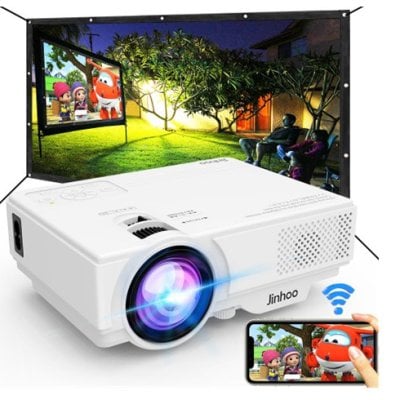
All of them are sold as smart projectors. The listings promise Wi-Fi 6, Bluetooth 5.4, an app launcher and streaming with no dongle attached, which means all of them carry an ARM SoC, DRAM and eMMC flash. The number three listing, an Alwtniet machine at $43.19, names its own silicon in its bullet points: an Allwinner H726 running Android 14. The reference design underneath it, the HY300 Pro, appears on the current chart under more than one logo and is documented at 1GB of DDR4 and 8GB of eMMC — a memory budget Android tablet makers abandoned years ago. It is also small enough that the dollar exposure per unit is small, which is the most plausible reason this chart has not moved while Roku’s and Microsoft’s did.
The six that went up in July have stayed up
On 1 August we counted six listings on this chart that had risen since our late-July readings, and said the thing worth watching was whether the ranks held at the new prices. Four days on, five of the six are still on the chart and still at the higher number.
- YGSKK’s electric-focus mini has moved up to number one and is holding at $75.99, against $69.98 in late July.
- AuKing’s 2026 refresh is at $69.99, up from $54.98, now at number twenty-two.
- AKIYO’s 2026 model is at $47.99, up from $41.93.
- Maypug’s built-in-apps mini is at $51.99, up from $49.98.
- ONOAYO’s ONO3Pro 2.0 is still at $402.99, a week after a 56% jump from $257.99.
The sixth is the exception, and not in the direction that helps a seller. Magcubic’s HY350Max, which crossed out of the sub-$100 bracket at $109.99, has dropped off the top twenty-four entirely. Two cheaper Magcubic listings remain, at $49.99 and $65.89.
The top end of the chart also turned over. The most expensive entry is now a $599.99 TOPTRO advertising VIDAA Live TV and 920 ISO lumens, which makes it the only machine on the list quoting brightness against a published standard — a role Epson’s EpiqVision Flex CO-W01 held a week ago before it fell off.
Two Roku projectors on a chart Roku just made more expensive
Aurzen has two machines on the list. The EAZZE D1R air is sixth at $149.99 and the D1R Cube is twenty-third at $179.99. Both are built around licensed Roku TV — the same platform, running on the same class of board, that Roku sells on its own in stick form. As of last week, a Streaming Stick 4K with no projector attached costs $79.99. The whole D1R air costs $70 more than that.
That gap is where the pressure lands first. Aurzen is paying for the Roku licence, the SoC, the DRAM and the flash, and then adding an LCD panel, an LED engine, optics, a USB-C power design that runs off a power bank, and a Dolby Audio licence — and selling the result for less than twice the price of Roku’s bare hardware. When we put the D1R air against the HY350Max a few days ago, the interesting difference was that Aurzen quotes 300 SGS-certified lumens where its rival claims 600. The interesting difference now is which of the two has a licence payment and a memory bill it cannot renegotiate.
The lever that does not show up on a price tag
TV brands have already been through this. TrendForce reported in January that memory’s share of a television’s bill of materials was going from 2.5-3% to 6-7%, that contract prices for the 4GB of DDR4 used in a 4K set had more than quadrupled in a year, and that retail price increases on new models were by then unavoidable.
Projectors at this end of the market have a second option that TV brands mostly do not, because almost nothing printed on the box is standardised. A seller can hold $49.99 and go from 2GB of RAM to 1GB, from 16GB of storage to 8GB, or from a licensed streaming app to a sideloaded one. Nothing in the listing needs to change except the specification table, and the specification tables on this chart are already doing badly on their own: the number three listing advertises “200ASIN” in its title, a typo for ANSI that has been live long enough to sell several thousand units.
The counterweight to that is measurement. The Dangbei N3 Max is built on the same single-panel LCD architecture as most of this chart — the same category of light engine, the same class of parts — but publishes 1,000 ISO lumens rather than a house figure, ships VIDAA with officially licensed Netflix rather than an APK, and states native 1080p and a 1.15:1 throw ratio instead of “4K support.” At $559.99 it is not competing with a $49.99 mini on price and does not try to. What it competes with is the idea that the spec sheet is negotiable, and in a year when the cheapest way to absorb a memory bill is to quietly change what is inside the box, a number that has to survive an ISO measurement is worth more than it was in January.
American back-to-school buying concentrates in the first three weeks of August, and the dorm-room projector is a recognised part of that basket. The sellers who raised prices in the last week of July raised them into demand, not away from it, which makes the next test the one after this one: whether $49.99 still buys the same machine in November, when the boxes on the shelf are being built against contracts signed this quarter. Roku has already answered that question for its own hardware. Nobody has put it to the chart.