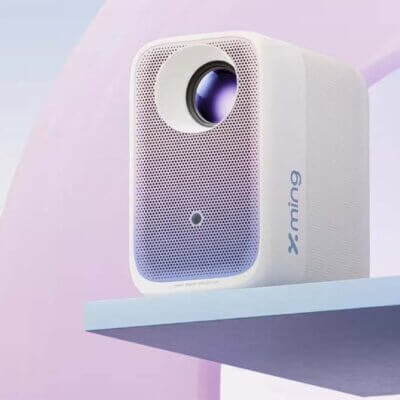
Xiaomi opened presales for two new REDMI projectors on Monday evening in China: the REDMI Projector 5 at a promotional 999 yuan (about $139) and the REDMI Projector 5 Pro at 1,899 yuan (about $264). Both went live at 8pm Beijing time on August 3 through Xiaomi’s own stores, JD.com and Tmall. The promotional pricing is dated — the fine print on Xiaomi’s own launch material puts the window at August 3 through 11:59pm on September 10, after which the two models revert to list prices of 1,299 and 2,199 yuan.
Both are native 1080p machines rated in CVIA lumens rather than the ANSI figure most of the world still quotes. The standard Projector 5 is rated at 400 CVIA lumens, throws a 1.2:1 image up to 120 inches, and claims 1,500:1 dynamic contrast. It runs a MediaTek MT9-series chip with 1GB of memory and 32GB of storage, dual-band Wi-Fi and a single 6W full-range driver. Focus and keystone are handled automatically by a ToF laser sensing module paired with Xiaomi’s correction algorithm, with off-axis placement supported out to about 20 degrees.
The Pro is a different machine underneath. It is rated at 1,000 CVIA lumens, adds a 120Hz refresh rate and 5ms input latency, HDR10 and MEMC frame interpolation, and moves up to the MediaTek MT9660 with 2GB of memory and 64GB of storage. Audio is dual 10W drivers plus a passive radiator with Dolby Audio decoding. Connectivity is the more telling upgrade: two HDMI inputs, one of them eARC, alongside a USB 2.0 port and a 3.5mm output — a set of ports that suggests Xiaomi expects this one to sit under a soundbar rather than get carried into the yard. Xiaomi quotes a floor of 28 dB(A) from a dual-loop air cooling design.
The gimbal is the cheap model’s headline, not the brightness
Where the two diverge most visibly is the mount. The 999-yuan model sits on a full 360-degree rotating gimbal that can be tipped straight up at the ceiling; the Pro’s integrated cradle covers 150 degrees of tilt but pairs it with up to 30 degrees of off-axis correction. That is a deliberate split. At 400 CVIA lumens the base model is a bedroom projector and Xiaomi has effectively said so by building it around the one feature bedroom buyers ask for. The Pro, at two and a half times the brightness, is aimed at a living room where the picture has to survive a lamp being on.
Against its own predecessor the Pro looks like a substantial step. The REDMI line has been iterating quickly, and the REDMI Projector 4 Pro that launched last October at 1,499 yuan was rated at 600 CVIA lumens with 2GB and 32GB. Ten months later the Pro badge buys 67 percent more measured brightness, double the storage, 120Hz, and a sealed optical engine with an all-glass lens that Xiaomi says resolves about 10 percent more detail than the previous generation. The launch price went up 400 yuan. On a lumens-per-yuan basis that is a straightforwardly better deal than the machine it replaces, which is not something you can say about most 2026 hardware refreshes.
One specification Xiaomi did not publish
Neither product page, nor the launch coverage on ITHome, MyDrivers or ZOL, states what imaging technology is inside either machine. There is no panel size, no chip type, no light-source description beyond “sealed optical engine.” That omission is not new — Xiaomi has been quiet about the imaging stack across several generations of the REDMI projector line — but it is worth noting plainly rather than filling in with an assumption. Contrast ratio is quoted for the base model as a dynamic figure, which tells you nothing about native performance, and the Pro’s contrast is not quoted at all.
What Xiaomi does commit to is the brightness number, and that is the part that carries weight. CVIA lumens are measured under a Chinese industry standard that specifies the test pattern, the warm-up state and the picture mode, and the figures on both machines are certified by an external lab rather than self-declared. We have written before about how CVIA and ANSI lumens differ; the short version is that a CVIA figure is deliberately conservative and is roughly comparable to a properly measured ANSI number, not to the inflated “light source lumens” that budget listings prefer.
Why a certified number matters more abroad than at home
Inside China, brightness certification has become table stakes — the RUNTO data we covered when Chinese smart projector sales fell 26 percent in the first half showed that even sub-1,500-yuan machines now ship with CVIA ratings. Outside China there is no equivalent. When we went through Amazon’s US best-seller list at the start of this month, half the top 24 sold for under $100 and the majority quoted no measurement standard at all — one listing had “200 ASIN” typed where a lumen figure was supposed to go. A US buyer spending the dollar equivalent of the Projector 5 is shopping almost entirely blind on the one specification that determines whether the picture is watchable.
That gap is the reason Chinese brands that have made it overseas tend to lead with certification. Dangbei is the clearest example: it publishes ISO 21118 lumens on its international models and holds the number to the same third-party discipline abroad that CVIA imposes at home. Its N2 mini sits in roughly the same price territory as the Projector 5 and covers the same use case with a 190-degree gimbal, automatic focus and keystone, and fan noise under 27 dB — but it also ships with Netflix officially licensed rather than side-loaded, which remains the single hardest thing to get right on a projector at any price. The certified brightness figure and the licensed streaming stack are the two things a buyer outside China cannot verify for themselves, and they are exactly what the export-focused brands have chosen to compete on.
It stays home
Neither REDMI model has an international SKU. Xiaomi’s projector business has been almost entirely domestic for several generations now, and nothing in the launch materials suggests that changes here — the software stack is built around XiaoAI voice control and Xiaomi’s HyperOS Connect ecosystem, with the projector able to trigger smart lights and curtains, which is a hard proposition to export without the rest of the house. Buyers outside China will find grey-market units, without the ecosystem, without licensed Western streaming apps, and without a warranty path.
Taken on its own terms the Pro is the more interesting of the two. A thousand certified lumens, 120Hz, eARC and 28 dB at 1,899 yuan is a specification sheet that would be competitive at twice the money in the US or Europe, and it is a reminder of how much of the value in this category is being set by a market most Western buyers never shop in. The base model is narrower — 400 lumens is a dark-room figure whatever standard measures it — but at 999 yuan with a 360-degree gimbal and automatic geometry correction, it is priced against products that in other markets ship with no verified specifications whatsoever.