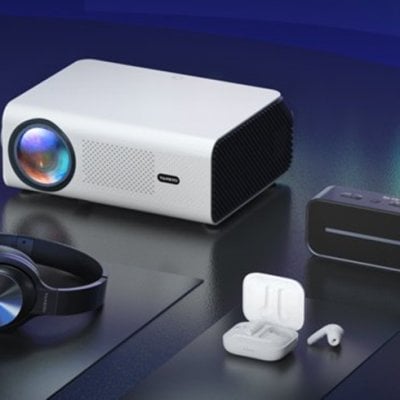
Two single-chip LCD projectors are sitting close together on Amazon’s projector best-seller list right now, and the cheaper one claims twice the brightness of the more expensive one. The Aurzen EAZZE D1R air is $149.99 and rated at 300 ANSI lumens. The Magcubic HY350Max is $109.99 and rated at 600. Both are native 1080p, both weigh next to nothing, both carry a 4.4-star average. On the specification sheets, the Magcubic looks like the obvious buy.
It is not that simple, and the reason is the one thing neither number tells you on its own: who measured it.
300 that was certified against 600 that was asserted
Aurzen puts its brightness figure through SGS and cites ANSI/ISO 21118 on the listing itself — the standard that specifies how the nine-point measurement is taken, what the projector’s warm-up state has to be, and how the result is reported. The company has built a marketing line out of it, which is a little grating, but the certification is a real, checkable thing and it is unusual at this price.
Magcubic’s 600 ANSI figure appears in a bracketed bullet with nothing behind it. There is no lab, no standard, no test conditions. It may be honest. It may be measured off the lamp rather than off the screen, which is how most sub-$100 projectors arrive at their numbers. There is no way for a buyer to tell, and that is the point — an uncertified lumen figure is not a smaller version of a certified one, it is a different kind of statement entirely. We went through this in detail when we compared CVIA and ANSI measurement, and the pattern holds here.
What the review columns suggest is that neither machine is bright. Aurzen buyers describe the D1R air as clearly watchable at dusk and behind closed blinds in daytime, and better once the room is fully dark. Magcubic buyers describe much the same envelope — fine in a dim room, best in a dark one — which is not what a genuine doubling of light output would look like. If the Magcubic really put 600 ANSI on a wall it would be visibly brighter than a 300-lumen machine in any side-by-side, and no one in the reviews reports that.
What happens the first time you want Netflix
The D1R air runs Roku TV natively. Not a Roku stick in an HDMI port — the Roku operating system is the projector’s interface, with Netflix, Prime Video, Disney+, Hulu, YouTube and Apple TV as licensed apps plus Roku’s free channel bundle. Reviewers mention this more than any other feature, usually in the form of relief that there is one remote and no dongle.
The HY350Max runs Android 14 on an Allwinner H726 with 1GB of memory and 8GB of storage, and it has no licensed Netflix app. Getting Netflix onto it means sideloading, and sideloaded Netflix on a device without the certification typically drops to standard definition when it runs at all. Every other major service has the same licensing structure. For a projector bought to watch streaming video, that is not a minor gap, and it is the single clearest thing the extra $40 buys.
The Magcubic gives something back on connectivity — Wi-Fi 6 and Bluetooth 5.4 against the Aurzen’s dual-band Wi-Fi and Bluetooth 5.2, plus HDMI 2.0 where the Aurzen’s HDMI spec is unstated. If your plan is to plug in a Fire Stick or a games console and ignore the built-in system entirely, the Magcubic is the better port for the money and the licensing question stops mattering.
Sound, setup and the power cable
Aurzen mounted the D1R air’s two 5W drivers in the base rather than the projector body, which gives the enclosure a larger sealed chamber. Buyers notice: the most repeated compliment in the D1R air’s reviews is that the sound is better than the size suggests, with several saying they stopped planning to add a speaker. Magcubic’s audio draws the opposite reaction. One recurring complaint is that the built-in speaker is mediocre enough to need an external one, and more than one reviewer pairs that with a note that the fan is audible when the volume is low. Aurzen quotes its own fan noise at under 35 dB in the brightest mode and 30 dB in eco; Magcubic publishes no noise figure.
Setup is close to a wash. Both do time-of-flight autofocus and automatic keystone, both correct in real time, and reviewers on both sides call the process fast. The most substantive picture complaint on the HY350Max is that focus softens toward the edges when the projector is tilted — several buyers describe it as invisible in film but obvious with text. That is a normal consequence of a cheap lens working off-axis and it is worth knowing before you plan a ceiling-angled setup. It was the same story when we put the HY350Max against the HAPPRUN H1 earlier in the summer.
The one place the Aurzen genuinely loses is power. It has no internal battery and needs 65W or more of USB-C PD, so taking it outside means taking a power bank or a wall socket with it. That is a deliberate trade — the USB-C route is why it weighs 2.6 pounds — but a projector marketed for backyard use that cannot run on its own is an awkward proposition, and it is fair to say the listing does not lead with it. The HY350Max has no battery either, but it also makes no portability claims beyond being small.
Which one to actually buy
If the projector is going to be a streaming device — a guest room, a dorm, a bedroom wall, something a house guest can operate without instructions — the D1R air is worth the extra $40 several times over, and the certified brightness figure means you know what you are getting rather than hoping. If it is going to be fed by an HDMI source and the built-in system is irrelevant, the HY350Max is the cheaper box with the better radio and the newer HDMI port, and the money saved is real.
The pricing on both moves. The HY350Max was $99.99 at the end of July and went to $109.99 in the first days of August, and Amazon’s sub-$150 projector listings reprice constantly — half the projectors on the best-seller list sold for under $60 this month, several of them after double-digit increases in a fortnight. Neither of these is a machine to wait on a sale for, but neither is the price you saw last week necessarily the price today.
The broader read is that the certification is the story. There are a dozen projectors between $30 and $150 on that best-seller list quoting lumen figures with nothing standing behind them, and one of the two machines here decided to pay a lab to check. That decision cost Aurzen a specification-sheet loss against a cheaper competitor, which is exactly why so few brands in this bracket make it. For a fuller picture of what the segment looks like above this price point, our guide to projectors under $500 for 2026 covers where the certified-brightness machines start to cluster. The full specification comparison for these two is on our comparison page.