GlowBox put its first projector on sale in China on Thursday, October 15, and the number it had kept back through a week of countdown posters turned out to be 699 yuan, about $104. For that, the R1 claims 620 CVIA lumens, a native 1080p LCD panel from BOE, a HiSilicon quad-core chip and a customized build of Dangbei OS that the company says shows no advertising at power-on or during screen casting.
The price and full specification were published on launch day by Mydrivers and Yesky, and both reports match on the core figures. When we first wrote about the R1 on Wednesday, GlowBox had named its suppliers but not a single brightness or resolution number, and Mydrivers was guessing at a price between 500 and 900 yuan. The real figure landed near the bottom of that range.
The spec sheet, finally
The R1 is rated at 620 CVIA lumens with a 3,000:1 contrast ratio and HDR picture processing, and it decodes 4K video while displaying it at the panel’s native 1920×1080. The lens is all glass, which GlowBox says keeps focus from drifting as the projector warms up. Throw ratio is 1.25:1: according to Mydrivers, the R1 needs 1.66 meters for a 60-inch picture, 2.21 meters for 80 inches and 2.77 meters for 100 inches, and it tops out at 120 inches. Those distances check out against the stated ratio.
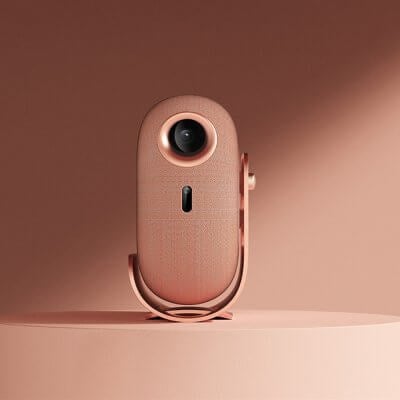
The body weighs 1.18kg and sits inside a fixed carrying handle that doubles as a stand, tilting through a full 360 degrees so it can be aimed at a ceiling without a separate mount. Autofocus and keystone correction use a time-of-flight sensor and a gyroscope; there is no camera. Audio is a pair of 3W speakers, rated noise is under 26dB, and wireless is Wi-Fi 6 and Bluetooth 5.4. Mydrivers lists HDMI, USB and a 3.5mm audio jack on the back. GlowBox is offering a seven-day free trial, replacement instead of repair within 30 days, and a two-year warranty.
The supply chain is unchanged from the September announcement. BOE makes the LCD panel, CVTE supplies the main board, Dangbei provides the operating system, and Shenzhen Kejinming (KJM), an established single-LCD assembler, builds the finished units on its own production line.
BOE versus TCL CSOT, at 400 yuan apart
The most useful comparison is not with another newcomer but with OBE’s C5 Pro, which went on sale in China on September 24. We covered it as part of OBE’s TCL CSOT panel story last month. The two machines are almost the same product on paper: native 1080p, 600 CVIA lumens for the C5 Pro against 620 for the R1, the same 3,000:1 contrast rating, a 120-inch maximum and the same under-26dB noise figure. Both sit on a gimbal-style stand and both advertise an operating system without boot-up ads.
The difference is price. The C5 Pro lists at 1,499 yuan and launched at 1,099, while the R1 starts at 699. That is 400 yuan less than OBE’s introductory price and 800 yuan less than its list price, for a projector that claims slightly more light. The panels behind those numbers come from China’s two largest display makers: TCL CSOT supplies OBE exclusively, and BOE is the name GlowBox put on its posters.
OBE does have answers for the gap. The C5 Pro adds a full-colour camera to its time-of-flight sensor and uses Scheimpflug correction to keep the corners sharp when the projector sits off-axis, and it runs a single 10W speaker against the R1’s two 3W drivers. Those are real differences for someone who will project from a bedside table at an angle. For buyers who mostly care about brightness, resolution and a clean interface, though, the R1 has reset the floor by a wide margin, and it has done so less than a month after OBE’s launch. We would expect the C5 Pro’s price to respond before China’s November 11 shopping festival.
There is a quieter detail in the optics. The R1’s 1.25:1 throw ratio is exactly what we calculated on Monday from Wanbo’s published distances for the Cube 2S, another compact single-LCD model. Two unrelated brands landing on the same ratio is not proof of a shared lens, but it fits the picture of this category: the optical layout is largely settled, and brands now compete on the panel, the brightness they can certify and the software.
Brightness claims, and a brand willing to argue about them
GlowBox spends a striking amount of its launch material attacking its own price class. One long promotional graphic lists the traps of budget projectors as brightness inflation (it cites “3,000 ANSI lumens” claims that measure under 300), resolution inflation and laggy software, then sets the R1’s certified 620 CVIA against unnamed rivals that publish no test reports. CVIA is a Chinese industry rating introduced to curb exactly that kind of inflation, so a 620 CVIA claim carries more weight than the five-figure “lumens” common on marketplace listings. It is still not the same as an ANSI or ISO figure, and our lumen guide explains why the units should not be compared one-to-one without a meter.
The software pitch is the other half of the argument, and it is where Dangbei’s role shows most clearly. GlowBox’s graphics describe Dangbei as the software service provider behind systems used by Sony, Samsung and LG, and the R1’s interface promises no advertising at boot and none in the casting screen. In China, full-screen power-on ads have been one of the most persistent complaints about cheap smart TVs and projectors. A new brand with no software team can’t easily build a reputation for a clean interface, so licensing Dangbei’s makes sense.
In dollars, and in America
At today’s rate of 6.71 yuan to the dollar, 699 yuan is about $104. China’s list prices include 13 percent VAT, while American prices are quoted before sales tax, so the like-for-like figure is closer to $92. The Chinese build has no licensed Netflix or other Western streaming apps, and GlowBox has announced no plans to sell the R1 outside China.
For American buyers, Dangbei’s own software comes on Dangbei’s own hardware. The Dangbei N2 mini is $199 on Amazon as of October 15, with a 4.4-star average from 266 ratings. It costs roughly twice the R1’s tax-free equivalent, and the extra money buys things the Chinese model does not offer: officially licensed Netflix, Prime Video and YouTube, InstanPro automatic focus, keystone and screen fitting, and a sealed optical engine that keeps dust out of the light path. In single-LCD projectors, dust in the light path is the most common long-term failure.
Every brightness and quality claim in the R1 launch comes from GlowBox and its suppliers, and no independent measurement has been published yet. Its own marketing argues that a spec sheet proves nothing until someone measures the picture. The first third-party reviews will show whether BOE’s panel delivers what the posters promise.