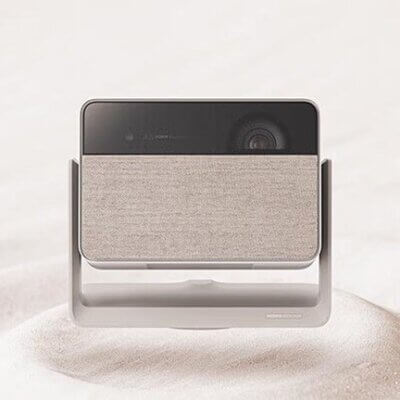
GlowBox, a projector brand that did not exist before September, will put its first model on sale in China on October 15, and the most notable name attached to it is not its own. The GlowBox R1 (小光盒 R1 in Chinese) runs a customized build of Dangbei OS, uses an LCD panel solution from BOE, and was built by a four-company consortium that the brand has chosen to advertise rather than hide. The price has not been announced.
The details come from two countdown posters GlowBox released last weekend and from coverage by Mydrivers on October 12 and 17173 on October 11. The day-four poster carries the BOE logo and the line “high-brightness LCD screen, built by BOE.” The day-three poster carries Dangbei’s logo with “deeply customized Dangbei OS solution” and a headline promising no advertising at power-on.
Who builds what
According to the brand’s September launch materials, reported by Tencent News on September 15, the R1 splits its supply chain four ways. BOE supplies the projection LCD panel, Guangzhou Shiyuan Electronic Technology (better known as CVTE, a large maker of TV and display main boards) supplies the main board, Dangbei provides the operating system and content ecosystem, and Shenzhen Kejinming Electronics handles final assembly and quality control.
The same launch introduced a second model, the GlowBox S1, which will use a larger 3.5-inch LCD panel against the R1’s 2.69-inch panel. GlowBox says it has raised more than 10 million yuan, about $1.5 million, in an angel round, and that the money is going into product development, inventory and brand building. It describes its target as the entry-level segment, which it says absorbs several million units a year in China but lacks products with a recognizable brand, adequate brightness and a setup that works out of the box.
Resolution, brightness, chipset, memory and speaker output have not been published. GlowBox says the full specification will be released on launch day.
Dangbei as a supplier, not just a brand
For readers outside China, Dangbei is known as a projector maker, with models such as the DBOX02, the N3 Max and the N2 mini sold on Amazon. At home it has a second business that is at least as old: its software. Dangbei’s app market and launcher have been installed on Chinese TV boxes and televisions for years, and the R1 shows the company is now willing to supply its full operating system to another projector brand. The R1 is the first new projector brand we have seen build its pitch around that licensed software, and put the Dangbei logo on its own marketing.
The timing is notable. Two days ago we covered the Wanbo Cube 2S, a single-LCD projector that ships with Hisense’s VIDAA operating system rather than Google TV. Within the same week, two Chinese companies that make their own projectors have shown up as software suppliers inside someone else’s cheap LCD box. In both cases the hardware is ordinary for its class and the software is the reason the product is newsworthy.
That makes sense once you look at what goes wrong with budget projectors. The light engine and panel are commodity parts. What separates a usable entry model from a frustrating one is mostly software: whether the streaming apps are licensed and play at full resolution, whether the interface is quick on a weak chip, whether updates arrive, and, in China specifically, whether the device opens with a full-screen advertisement every time it is switched on. Power-on advertising has been one of the most persistent complaints about Chinese smart TVs and projectors, and GlowBox chose it as the headline of an entire poster. Dangbei’s interface is known in China for being light and fast, and for a new brand with no software team of its own, licensing it is cheaper and more credible than building one.
BOE joins TCL CSOT in LCD projection
The panel credit matters too. Last month we reported that OBE’s new single-LCD projectors use panels and light engines supplied by TCL CSOT, China’s second-largest display maker. With BOE now named on the R1, both of China’s biggest panel manufacturers are publicly associated with single-LCD projection in the same quarter. Single-LCD projectors used to be built around panels whose origin no one advertised. Brands are now treating the panel supplier as a selling point, much as phone makers do with display suppliers.
Panel size is still a real difference. OBE moved its R3 Ultra series to a 5-inch panel this year, up from 4.45 inches, while the R1 uses 2.69 inches. In a single-LCD design all the light has to pass through the panel, and a smaller panel generally means a smaller, cheaper optical path and less light delivered to the screen for the same lamp, which fits the R1’s entry-level positioning. GlowBox has not published a lumen figure, so how much brightness it gets from BOE’s “high-brightness” panel is still unknown.
What it might cost, and what Americans can buy instead
Mydrivers estimates a price somewhere between 500 and 900 yuan, which would be roughly $75 to $134 at today’s exchange rate. That is the outlet’s own estimate, not a figure from GlowBox, and we will update when the real price is published on October 15. There is no sign of an international launch.
American buyers who want Dangbei software on a compact LCD projector already have a direct option in Dangbei’s own N2 mini. It costs $199 on Amazon as of October 14, with a 4.4-star average from 265 ratings, and it ships with officially licensed Netflix, Prime Video and YouTube, something that most sub-$200 LCD projectors on Amazon cannot claim. It also adds InstanPro automatic focus, keystone and screen fitting, and a sealed optical engine. Sealing matters on LCD projectors, because dust inside an open light path shows up as permanent dark spots on the image, which is one of the most common long-term complaints about cheap LCD models.
The open question for the R1 is whether a projector assembled from four suppliers’ parts can match one where a single company controls the optics, board and software together, which is the approach Dangbei takes with its own models. GlowBox is betting that the names on the box will reassure buyers before any reviews exist. The specification sheet on Thursday will show how much of that confidence comes from the parts and how much from the posters.