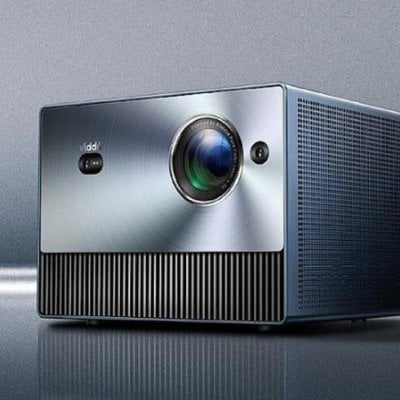
Xiaomi put the standard REDMI Projector 5 on open sale in China on Tuesday at a launch price of 999 yuan, roughly $139, with a list price of 1,299 yuan once the introductory window closes. The brighter Projector 5 Pro reached retail a day earlier at 1,899 yuan against a 2,199-yuan list. Both ship through Xiaomi’s own stores, JD.com and Tmall. Neither has an international SKU.
The retail listings answer something the launch materials did not. When the pair opened for presale on August 3, no product page, spec sheet or piece of launch coverage said what imaging technology was inside either machine — no panel size, no chip type, nothing past the phrase “sealed optical engine.” The product entry that went live with the sale on ZOL’s hardware database, which is populated from manufacturer sheets, lists the display technology on the 999-yuan model as LCD. Chinese trade coverage of the launch went further, treating the Projector 5 as Xiaomi’s return to the single-panel LCD segment it used to lead — a company that had dropped out of the category’s top three, working its way back up from the roughly 600-yuan band where REDMI projectors have sold on volume for several generations.
What a single-panel engine explains
The label makes the rest of the sheet cohere. 400 CVIA lumens. A 1.2:1 throw ratio topping out at 120 inches. A contrast figure quoted only as 1,500:1 dynamic, with no native number anywhere. A MediaTek 9-series chip with 1GB of memory and 32GB of eMMC, and a single 6W driver. That is the shape of a 1LCD machine, and saying so is not a knock. Single-panel LCD is the reason a projector can carry a ToF laser module, automatic focus, automatic keystone out to about 20 degrees off-axis and a full 360-degree metal gimbal at 999 yuan. A DLP light engine at that brightness would have eaten the budget for all of it.
What the technology also explains is the missing native contrast number. Single-panel LCD does not produce deep blacks; the panel leaks, and manufacturers quote a dynamic figure that measures the light source dimming rather than the panel. Xiaomi quoting 1,500:1 dynamic and stopping there is the honest version of an awkward answer. The 400-lumen rating carries the same message: this is a bedroom machine for a dark room, and the 360-degree gimbal that lets it fire straight at the ceiling is aimed squarely at the people who will use it that way.
Climbing, not descending
Read against the market the launch looks less like a budget play and more like a company moving up. REDMI’s projector line has lived below 1,000 yuan for years on the strength of undercutting everyone; a 999-yuan launch price with a 1,299-yuan list, plus a Pro at nearly 1,900, is a step into a tier where buyers compare specifications instead of just prices.
It is also a step into a shrinking room. RUNTO’s first-half numbers, which we covered when Chinese smart projector sales fell 26 percent, showed the sub-500-yuan end collapsing while brightness certification spread downward into machines that would once have shipped with no measured figure at all. A brand climbing from 600 yuan to 1,000 yuan in that market is not chasing volume. It is chasing the part of the market that still has margin in it.
The Pro is arguing something else entirely
The 1,899-yuan model is not a brighter version of the same idea. It is rated at 1,000 CVIA lumens, adds a 120Hz native refresh rate with 5ms input latency, HDR10 and frame interpolation, and moves to the MediaTek MT9660 with 2GB and 64GB. Audio is dual 10W drivers plus a passive radiator with Dolby Audio decoding. The connector layout is the tell: two HDMI inputs, one of them eARC, which is a set of ports for a machine that will sit under a soundbar in a living room rather than get carried outside. Xiaomi quotes a 28 dB(A) floor from a dual-loop cooling design and an all-glass lens in a sealed engine.
Xiaomi has not stated the imaging technology on the Pro either, and no database entry we could find fills it in. Given 1,000 certified lumens, 120Hz and the price, an assumption would be easy to make and we are not going to make it.
A thousand certified lumens, priced two ways
The certification is the part that travels. CVIA lumens are measured under a Chinese industry standard that fixes the test pattern, the warm-up state and the picture mode, and both REDMI figures are lab-verified rather than self-declared. There is no equivalent discipline in the markets where most of our readers shop. On Amazon’s US best-seller list this week, 13 of the top 24 projectors sell for under $60, and the majority quote no measurement standard at all — a pattern we went through in detail when half the list came in under $60 at the start of this month. A buyer spending the dollar equivalent of a Projector 5 outside China is shopping blind on the one number that decides whether the picture is watchable.
Which makes the comparison worth drawing plainly. The REDMI Projector 5 Pro is rated at 1,000 CVIA lumens and cannot be bought outside China. The Dangbei N3 Max is rated at 1,000 ISO lumens — the international standard, held to the same third-party discipline — and can. It runs VIDAA with Netflix officially licensed rather than side-loaded, handles focus and keystone automatically, and puts 12W of Dolby Audio behind it. Dangbei has built its export business on exactly the two things a buyer abroad cannot verify for themselves: a certified brightness figure and a streaming stack that is licensed rather than improvised. That is a harder position to hold than a low price, and it is why the brand shows up on shortlists in markets Xiaomi’s projector division has never entered.
The open question
Single-panel LCD spent a decade as the technology of the 300-yuan gadget aisle, the thing you bought when you wanted a projector shape rather than a projector. What Xiaomi has done here is put it on a 360-degree gimbal, wrap it in a sealed engine, attach a laser rangefinder and a certified brightness figure, and ask 999 yuan for it. Whether the segment it used to dominate will pay that is the thing worth watching over the next quarter — and whether the certification habit that made this launch legible at home ever crosses the border into the markets where a $50 projector still claims 20,000 lumens and nobody checks.