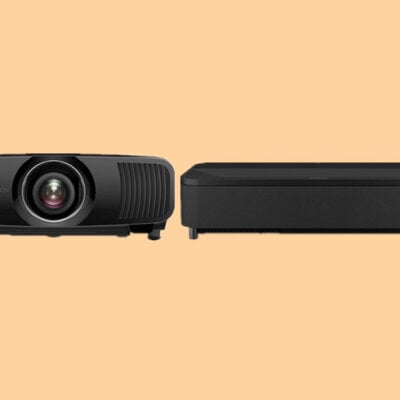
Epson’s LifeStudio Grand Plus is now on sale in every major market it was built for, listed at $3,799 in the US, and the number that stands out three months into its life is not the one on the box. Two independent test labs have put the 4,000-lumen ultra short throw on a meter, and both came back with readings above Epson’s own rating — a result that has become genuinely rare in a category where published brightness figures usually flatter the hardware.
The projector, sold as the EH-LS970W in Europe and Asia and simply the LS970 in the US, is a three-chip 3LCD design with a laser light source, an ultra short throw lens rated at 0.16–0.40:1, and a 2.1-channel Bose speaker system built into the chassis. It sits about an inch from the wall for an 80-inch image and stretches to 150 inches. Three HDMI inputs, one with eARC, handle 4K at 120Hz with auto low latency mode. The laser is rated for 20,000 hours. Epson shipped it in Europe in April with a five-year warranty, brought it to Korea in June, and spent late July building a market argument around it.
Two labs, two sets of numbers
ProjectorCentral measured 4,451 ANSI lumens in Dynamic, 4,050 in Standard, 3,783 in Cinema and 3,694 in Natural. Projector Reviews, testing a separate sample, logged 4,081 lumens in the brightest mode. The two houses are roughly 9% apart, which is normal sample-and-method variance, but the direction is the same in both: the LS970 hits its rating and keeps going, and it does not collapse when you leave the brightest preset. Standard mode still lands within a rounding error of 4,000.
That second detail matters more than the headline figure. Most projectors quote a number achievable only in a mode nobody watches films in — the one with the green push, where the picture is bright and wrong. Epson’s spread between its brightest preset and its most accurate one is about 17%. Compare that with the XGIMI Elfin Flip 4K, which reviewers clocked at just over 1,550 lumens in its brightest mode but barely 1,200 in movie mode, roughly a quarter under its 1,600-lumen rating. Published figures are drifting in both directions this year — the Samsung Freestyle+ was measured at close to double what its spec sheet promised — which is precisely why a rating that simply holds is worth pointing at. For a projector meant to live in a lit living room and replace a television, that flatness is the specification.
There is a structural reason for it. 3LCD splits light across three panels and recombines it, so color brightness and white brightness come out the same — Epson rates both at 4,000 lumens, one under the IDMS color standard and one under ISO. Single-chip DLP designs spin color sequentially through a wheel, and their color output is typically a fraction of their white output. On a screen with the lights on, that gap is what you actually see. It is the argument Epson has been making for two decades, and on this unit the meter backs it.
Where the 8.3 million pixels come from
Epson has been describing the LS970 as a “real” 4K projector that puts all 8.3 million pixels of a 4K frame on the wall. Both review labs report the same underlying hardware: three native 1080p LCD panels driven by dual-axis pixel shifting, which steps the image through four positions fast enough that 8.3 million distinct pixel locations are addressed per frame.
Whether that counts as “real” 4K depends on which definition you are holding. The panels are not 3840×2160. The addressed pixel count on screen is. Four-phase shifting is a meaningful step up from the two-phase shifting used on cheaper projectors, which only doubles 1080p, and in practice the LS970 resolves fine detail well — sharpness was a strength in both reviews. But buyers comparing it against a native-4K DLP chip should know they are comparing different mechanisms that arrive at a similar destination, not identical silicon. Epson’s phrasing is defensible; it is also carefully constructed.
Contrast and color are the trade
The rated contrast figure is 5,000,000:1, which is a dynamic number produced by modulating the laser. Measured native contrast came in around 1,800:1 at ProjectorCentral and roughly 1,478:1 at Projector Reviews. Those are ordinary LCD numbers, and they are the honest cost of the brightness. Black floors on this projector are grey in a fully dark room, and no amount of laser dimming disguises that on a mixed scene.
Color volume is the other concession. ProjectorCentral put gamut coverage at about 78% of DCI-P3. Triple-laser rivals in the same price bracket clear that comfortably — RGB engines are the reason the current crop of premium ultra short throws advertise BT.2020 figures at all. If your viewing is mostly HDR films in a controlled room, that shortfall shows up in saturated reds and deep cyans. If your viewing is daytime sport, news and streaming on a 120-inch wall, it largely does not.
Two more omissions are worth flagging because they are unusual at this price: there is no 3D support and no Dolby Vision. There is also no Ethernet port, which will irritate anyone wiring a dedicated media room.
Epson’s argument about AI
The LS970 is Epson’s first projector to ship Google TV with Gemini, and the company has leaned on that hard. It also carries what Epson describes as a TV-class AI processor that analyses scenes in real time and adjusts brightness, contrast and color per frame.
What makes the positioning interesting is the caveat Epson attached to it. Speaking to Seoul Economic Daily in late July, the company framed the AI projector market as growing from $5.91 billion this year to $13.4 billion by 2030 — and then argued that the more capable the AI becomes, the more the optical and display stack decides the outcome, because the panel is what has to render the result. That is a vendor talking its own book, obviously; Epson sells the optics. But it is also a reasonable read of where the category is heading. Every projector launched this year has an AI story. Very few of them have a brightness figure that survives contact with a meter.
Against the triple-laser field
At $3,799 the LS970 lands in the middle of a crowded shelf. The Hisense PX4 Pro is $3,999 with 3,500 rated lumens, an RGB triple-laser engine and a far wider gamut, but ships without Google TV. AWOL Vision’s Aetherion Max sits at $4,499 with 3,300 lumens and was called the best ultra short throw it has tested by What Hi-Fi, largely on the strength of its black levels. Both of those beat the Epson on color and contrast. Neither beats it on raw light, on color brightness parity, or on the five-year warranty.
Which is a clean split, and an unusually clear one for buyers. If the room is dark and the content is film, the triple-laser machines are worth the premium and the compromises. If the room has windows, the screen is going on a living room wall, and the projector has to work at four in the afternoon as well as ten at night, the 3LCD box is the one whose numbers hold up — including the ones Epson printed on the box. For a broader look at how the category is priced right now, our 2026 guide to 4K projectors for movies covers where the rest of the field has landed.