Three thousand dollars used to be the entry price for a projector worth putting in a dedicated room. It is now the ceiling of a very crowded shelf, and the reason is that almost nothing in this bracket still sells for what it launched at.
We keep a price on every machine in our product database and we re-check them against Amazon rather than against manufacturer press releases. Running that check on 28 August 2026 turned up gaps large enough to change which projector a person should buy. The Valerion VisionMaster Pro 2 had been carried at $2,999 and sells for $2,499. The Hisense C2 Ultra had been carried at $2,999 and sells for $2,297.97. The Dangbei MP1 Max had been carried at $1,999 and sells for $1,298.99. The XGIMI Horizon S Max, listed at $1,899, is $1,214.65.
None of those are flash sales with a countdown clock. They are the standing price, and they mean the useful question in this bracket is no longer “what can I afford” but “what does the extra thousand actually buy”. Every price below was checked on the day of writing. Every brightness figure is quoted in the unit the manufacturer publishes it in, because those units are not interchangeable and the difference between them is the single most misleading thing on this shelf.
A note on the brightness numbers before you read any of them
Three units appear in this guide. ISO lumens (properly ISO 21118) and ANSI lumens are both measured to a published standard, and a figure carrying either one can be argued with on the merits. A bare “lumens” with no standard attached can mean anything at all. In the bracket below, everything is rated in ISO or ANSI, which is why this is a pleasant category to shop in and the sub-$200 shelf is not.
Contrast is the opposite situation. You will read 3,000:1 on a Hisense and 100,000:1 on an XGIMI in the same paragraph, and the Hisense is not thirty times worse. One is a native figure and the other is a dynamic one, arrived at by dimming the laser between scenes. Where a native number exists we have said so.
Hisense PX3-PRO — $2,797.97
The most expensive thing here and the only ultra short throw, which makes it the pick for anyone who cannot put a projector eight feet behind the sofa. It sits inches from the wall and fills 80 to 150 inches from there, with no ceiling mount and no cable run across the room.
Hisense rates it at 3,000 lumens with a 3,000:1 contrast ratio and full 110% BT.2020 coverage from its TriChroma triple laser engine, and quotes colour accuracy at ΔE≈0.9 — a specification most brands in this bracket simply decline to publish. Native 4K on a DLP chip with 2.07 million micromirrors, Dolby Vision, and a 4K AI upscaler for everything that is not natively 4K. It holds a 4.4 rating across 134 reviews.
The honest caveat is the one every UST carries: it needs a flat wall or an ambient-light-rejecting screen to look like the demo, and that screen is a separate four-figure purchase in many rooms. Our ultra short throw guide for 2026 covers what happens when it does not get one.
XGIMI HORIZON 20 Max — $2,599.00
The brightest conventional projector in this guide by XGIMI’s own numbers: 5,700 ISO lumens from the X-Master RGB triple laser engine, 20,000:1 contrast, 110% BT.2020. That is genuinely a daylight machine rather than a machine with “daylight” in the marketing copy.
What earns it the price over the cheaper Horizon 20 is the optics. It has both lens shift and optical zoom, which means it can be placed where the room allows and squared up without digital keystone throwing away pixels. Google TV and Google Home are built in, gaming runs at 1ms input lag and 240Hz, and XGIMI ships it with a two-year warranty rather than the usual one. Rated 4.3 across 77 reviews.
Valerion VisionMaster Pro 2 — $2,499.00
The best-reviewed projector in the bracket by a distance — 4.6 across 652 ratings, which is roughly five times the review base of anything else here and the closest thing to a consensus this shelf produces.
Valerion is AWOL Vision’s premium long-throw sub-brand, and the Pro 2 is built to be argued about on contrast rather than brightness: 15,000:1 with an Enhanced Black Level system, a 0.9–1.5 throw ratio through the OpticFlex lens with auto focus and keystone, AI Super Resolution on the upscale, and HDR10+ with dynamic tone mapping. The processing is a MediaTek MT9618 with 4GB of RAM and 128GB of storage, which is more silicon than this class usually gets and shows in how quickly Google TV moves. Gaming is 4ms at 240Hz with 21:9 and 32:9 support.
It is also the machine most likely to be repriced again soon, for a reason that has nothing to do with the hardware: the organisation behind it has just co-founded a rival premium brand with XGIMI that debuts at CEDIA on 1 September. Full specifications are on the VisionMaster Pro 2 product page.
JMGO N3 Ultimate — $2,349.00
The specification-sheet winner, and the one to buy if the room is awkward. Four-way lens shift at H ±53% and V ±130% with a 0.88–1.7:1 zoom means it will square up from almost anywhere, including well off-axis, which is a genuinely rare capability under $2,500.
JMGO rates the MALC 5.0 triple laser engine at 5,800 ISO lumens, the highest claimed figure in this guide, with Dolby Vision, 3D, and a 300-inch maximum image. Contrast is quoted as 20,000:1 AI dynamic black and 3,000,000:1 dynamic — read the first number and ignore the second. Gaming runs 240Hz at 1ms on an MT9679 with the DLPC8445 chip, and Google TV is the official build with native Netflix rather than a sideload. Rating is 4.2 across 67 reviews, the thinnest review base of the expensive picks. Specifications on the N3 Ultimate page.
Anker Nebula X1 — $2,299.00
The one with the most third-party verification behind it. 3,500 ANSI lumens, a native 5,000:1 contrast delivered by a physical six-blade iris rather than laser dimming, and a 14-element all-glass lens. Anker had it ISF-calibrated and has TÜV Rheinland certification across four separate benchmarks — brightness, colour accuracy, contrast and blue light — which is a longer list of outside checks than anything else in this guide carries.
It also auto-aligns: the projector scans the surface and sets position, size and focus in one pass, which matters more than it sounds when a 300-inch image is involved. 4.5 across 109 reviews. The X1 product page has the full specification. Anker’s newer X1S lists at $3,299 on Amazon, above this guide’s ceiling, though soundcore’s own store has been running it at $2,499 until 20 September.
Hisense C2 Ultra — $2,297.97
Seven hundred dollars cheaper than the price we had been carrying, and the most flexible thing here physically. A 360-degree horizontal rotation with 90 degrees up and 45 degrees down means it can throw at a wall, a screen or the ceiling from wherever it happens to be sitting, and the 1.67x optical zoom across a 0.9–1.5:1 throw ratio lets it fill 65 to 300 inches without moving.
Hisense rates it at 3,000 ANSI lumens with 2,000:1 contrast from a pure triple laser source, with Dolby Vision, IMAX Enhanced certification and JBL-tuned sound. The rating is 4.2 across 181 reviews, the softest of the premium group, and the contrast figure is the weakest here — this is a bright, versatile, colourful projector rather than a black-level one. Specifications on the C2 Ultra page.
XGIMI HORIZON 20 — $1,559.00
A thousand dollars less than the Max version, and the compromise is brightness rather than features. 3,200 ISO lumens instead of 5,700, but the same X-Master RGB triple laser engine, the same lens shift and optical zoom, IMAX Enhanced, Dolby Vision and HDR10+ together, Filmmaker Mode, Harman Kardon speakers, an integrated stand and the same 1ms/240Hz gaming with VRR and ALLM. Contrast is quoted at 100,000:1, which is a dynamic figure.
For a room with any light control at all, this is where the value in the whole bracket sits. Rated 4.3 across 131 reviews.
JMGO N1S Ultimate — $1,479.00
The gimbal machine. A 360-degree horizontal and 135-degree vertical mount built into the base means it points anywhere including straight up, with real-time auto keystone and focus that re-square the image within a second of being knocked.
3,300 ISO lumens from the triple laser engine, Google TV 3.0 with certified Netflix, and a 20W subwoofer with 45Hz bass, DD+ and DTS-HD Master Audio — the best audio hardware in this guide by some margin, which matters for anyone not running an external system. It has 342 reviews at 4.3, the largest review base here after the Valerion, which suggests it has been selling steadily rather than arriving last month.
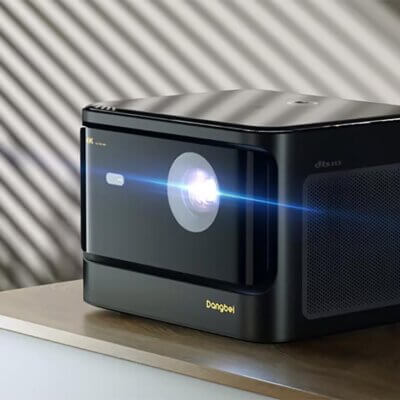
Dangbei MP1 Max — $1,298.99
The best value on this page, and the gap is not close. Seven hundred dollars below the price we had been carrying, the MP1 Max pairs a hybrid triple laser and LED engine rated at 3,100 ISO lumens with full 110% BT.2020 coverage — the same colour claim as machines here costing twice as much, and rated in ISO rather than an unqualified figure.
The practical advantages stack up quickly. Netflix is officially licensed on Google TV rather than sideloaded, which sounds like a footnote until you own a projector where it is not. InstanPro AI handles auto focus, auto keystone, screen fit and obstacle avoidance without a menu. The stand is built into the body with 360 degrees of horizontal rotation and 135 degrees of tilt, so there is no tripod to buy. Audio is two 12W drivers into a 750cc chamber with a bass-reflex port, carrying both Dolby and DTS:X. Rated 4.4 across 67 reviews. The MP1 Max product page has the rest.
If even that is more than the room justifies, the Dangbei DBOX02 is $948.99 today — 2,450 ISO lumens, 4K, Google TV with licensed Netflix, 4.4 across 205 reviews — and it is the point at which this guide hands over to our under-$1,000 list.
How the shelf actually splits
There are three real decisions in this bracket and none of them is about the logo.
The first is whether the room can take a long throw. If it cannot, the PX3-PRO is the only answer here and the screen budget goes up.
The second is whether the room can be darkened. In a controlled room, the extra 2,500 ISO lumens between the Horizon 20 and the Horizon 20 Max buy nothing you will see, and the thousand dollars is better spent on a screen or left in the bank. In a room with windows, that same gap is the whole purchase.
The third is optics. Lens shift and optical zoom are the features that separate a projector you place where it works from one you place where it fits, and in 2026 they are available from $1,559 upward — which is roughly half what they cost two years ago. That, more than any brightness figure, is what has changed about this price band. For the machines above $3,000, our laser projector guide for 2026 picks up where this one stops.