XGIMI and AWALL said on August 25 that they have co-founded an American home entertainment brand, XWALL by XGIMI, with AWALL acting as its exclusive United States sales and service partner. The first product is a flagship home cinema projector built on XGIMI’s most advanced projection platform, and it will be uncovered on September 1, the opening day of CEDIA Expo in Denver. Neither company has said what it costs.
Both sides were unusually careful about what the arrangement is not. It is not a distribution agreement. XGIMI contributes the engineering and the manufacturing scale; AWALL contributes the American channel and will run dealer recruitment, training and channel programs nationwide. Every XWALL product carries a three-year warranty backed by AWALL’s US-based service team, with professional calibration and customized configuration bundled into the sale rather than sold as an add-on. Sales run through AWALL’s specialty dealers, integrators, retail accounts and online storefronts. The demonstration space in Denver is a calibrated room shared between XGIMI’s booth 3327 and AWALL’s booth 4107, and the two companies are holding joint press sessions on the floor.
The channel is the actual asset
AWALL is led by Steven Shulman as chief executive and Michael Yanoff as president. Shulman founded AWOL Vision, the ultra short throw laser brand that spent years building exactly the kind of American dealer footprint XGIMI does not have — including a buying-group partnership with Nationwide Marketing Group that put its projectors and installation support in front of independent retailers through the Oasys residential technology group.
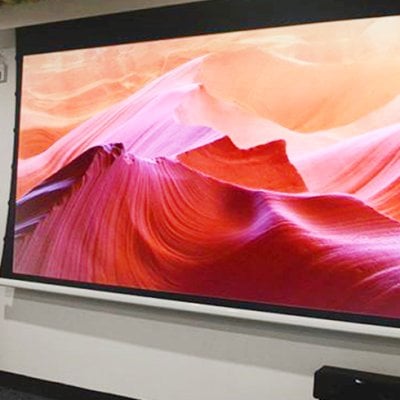
AWALL is the emissive-display side of the same house. It showed Phoenix at InfoComm in July, a motorized MicroLED panel that lies flat and then unfolds and rises into a 135-inch screen, which is a fairly direct statement that the organization no longer thinks of itself as a projector company. And in 2024 AWOL Vision added Valerion as a premium long-throw sub-brand, splitting the catalog so that AWOL Vision keeps ultra short throw and Valerion takes the traditional front-projection buyer.
Count them and the picture gets interesting. The people who will sell XWALL by XGIMI in America also sell AWOL Vision ultra short throw projectors, Valerion long-throw projectors, and MicroLED walls that exist to replace all of the above. XWALL is the fourth display line under that roof and the second one aimed squarely at a dark room with a screen on the far wall.
XGIMI already had the hardware. It did not have the room.
XGIMI’s side of this makes sense immediately. Its American business runs on Amazon, Best Buy and its own web store, which is a perfectly good way to sell a $999 lifestyle projector and a poor way to sell a reference machine. The company built the reference machine anyway. As of Friday its US store lists the TITAN Noir at $3,999 and the TITAN Noir Max at $5,999, both in stock, and the specification sheet for that line gives the built-in operating system as none — a deliberate reversal for a company whose reputation was made by welding Android TV to a projector chassis. We went through the bench measurements and the dual-iris claims when the same line was dated for Japan earlier this month.
Somebody paying $5,999 for a projector with no streaming apps is not shopping a product page. That buyer is asking about throw distance, screen gain, ceiling mounts, calibration, and who drives out when the light engine fails four years from now. XGIMI has had the machine for that customer since June and no credible way to reach him. Renting the relationship from the man who spent years building it is faster than building it, and a good deal more honest than pretending a listing page counts as a dealer network.
The number that will define it
Pricing is where the arrangement gets awkward, because the shelf is already crowded from the inside. Valerion’s VisionMaster Pro 2 sells on Amazon for $2,499 as of Friday morning, with a 4.6 average across 652 ratings. AWOL Vision’s own ultra short throw flagships sit above that — the Aetherion line opened in Japan at ¥369,800 earlier this month. If XWALL’s first product really is built on XGIMI’s most advanced platform, the only platform that description fits is the one underneath TITAN Noir, and the natural landing zone for a dealer-only, calibration-included, three-year-warranty version of that machine is somewhere north of $3,999.
Which puts an AWALL dealer in an odd room. He will have to explain to the same customer why the Valerion on the left is $2,499 direct from Amazon, why the XWALL on the right costs meaningfully more, and why the answer is service and calibration rather than pixels. That is a defensible argument in custom installation — it is roughly the argument the whole trade runs on — but it only holds if the two products are visibly different machines for different rooms. If they overlap, the dealer competes with his own catalog, and the cheaper brand wins because the customer can buy it on his phone.
The three-year warranty is the tell. Consumer projectors in this class ship with one year, occasionally two. Committing to three with a domestic service team attached is expensive in a product where the light engine is the failure point, and it is not the sort of promise a company makes to defend a $2,500 price. It is the sort it makes to justify a much higher one.
A show that has been losing its reveals
The September 1 date says something about CEDIA too. Most of this year’s projector news was spent before August ended, a pattern we traced through the Denver and Berlin calendars three weeks ago: the flagship laser announcements went into CES in January, Hisense put the PX4 Pro on sale in July, Fujifilm shipped a 12,000-lumen model three and a half weeks before the show rather than holding it for the floor. What is left for a trade show is precisely what cannot be sold from a product page — a calibrated dark room, an integrator willing to argue with the engineer who designed the thing, and a brand launch that only means anything to people holding a dealer account.
XWALL is the second kind of announcement. There is no consumer reason to care about it until the price appears, and possibly none afterward, since the entire point is that it will not be sold the way XGIMI’s other products are sold. What it does signal is that a Chinese consumer projector maker with a genuine flagship decided the American premium market cannot be entered from a listing page, and that the cheapest way in was to co-found a brand with the people who already own the relationships. If that works in Denver it will not stay a one-off. Hisense, Formovie and JMGO all have the same problem, and none of them has solved it either.