CEDIA Expo opens at the Colorado Convention Center in Denver on 1 September, with the exhibit floor running 2 to 4 September. IFA opens at Messe Berlin on 4 September and runs through the 8th. The two shows that carry most of the autumn projector news therefore overlap by a day, on opposite sides of the Atlantic, and both are now inside the three-week window where manufacturers start confirming what they are bringing.
So far the projection side of the Denver floor is being built by the people who sell rooms rather than boxes. AWOL Vision is listed at booth 4019, Elite Screens has confirmed a 10-by-30 stand at booth 3027, and Barco Residential appears in the exhibitor directory. The CEDIA directory describes hundreds of exhibitors across lighting, security, audio, video and control, which is the balance the show has been moving toward for several years: projection is one category among many, not the headline act.
What is already confirmed for the Denver floor
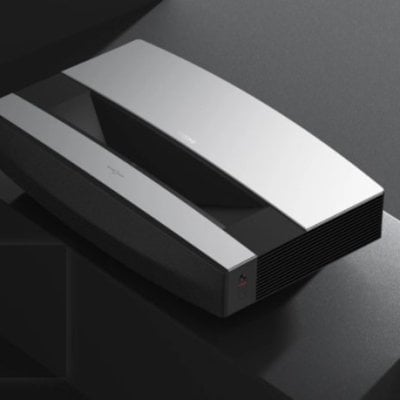
AWOL Vision arrives with the Aetherion line it introduced in the spring rather than something new. The Aetherion Max is a triple-laser ultra short throw rated at 3,300 ISO lumens with a 6,000:1 native contrast ratio and 110% coverage of Rec.2020, and it sells for $4,049 as a bare projector before the screen bundles that make up most of the company’s listings. The Aetherion Pro sits below it at 2,600 ISO lumens and $2,974, throwing up to 200 inches. Both carry variable refresh rate support and a claimed 1ms latency, which tells you where the category thinks its buyers are coming from: the same living rooms that were being sold a large television two years ago.
The screen half of the show is where the newer hardware is. Screen Innovations announced the KAOS 360, a double-sided outdoor screen that scales to 24 feet, on 5 August specifically for CEDIA, and Elite Screens has not said which products it is bringing. That pattern is normal for this show. Screen and mount manufacturers debut at CEDIA because the buyers on the floor are the integrators who specify them; projector manufacturers increasingly do not, because their buyers are watching a different calendar.
The Berlin half of the week
IFA is the larger event by an order of magnitude. The 102nd edition expects more than 1,800 exhibitors and around 245,000 visitors from roughly 140 countries, and it is a consumer show rather than a trade one, which historically made it the place where portable and lifestyle projectors were launched into Europe. IFA has been expanding its Creator Hub and Beauty Hub formats for 2026, a reminder that projection competes for floor attention against categories with far larger unit volumes.
The projector brands that have used Berlin well are the ones that treat it as a European product launch rather than a technology showcase. Dangbei has done exactly that three years running — the Atom in 2023, the Freedo in 2024 and its 2025 flagship lineup — and each time the announcement was a machine with a European price attached rather than a concept. Anker took the same approach when the Nebula X1 Pro debuted at IFA 2025. If either company follows its own pattern, Berlin is where the next portable gets a number.
Most of this year’s launches already happened
The complication for both shows is that 2026 front-loaded itself. Hisense and XGIMI put their flagship laser announcements into CES in January. XGIMI then opened orders for the Elfin Flip 4K and Elfin Flip Laser on 15 July, at $999 for the 4K model with a launch promotion that expired at the end of the month, and reached Amazon a week later. Hisense put the PX4 Pro on sale on 21 July. Fujifilm shipped the 12,000-lumen ZUH12000 and its rotating ultra short throw lens on 6 August, three and a half weeks before Denver, rather than holding it for the floor.
None of that is accidental. A projector announced in July is on retail shelves for the entire American back-to-school period and the whole European autumn; a projector announced on 3 September is not. The shows still matter for the parts of the business that cannot be sold from a product page — a 24-foot screen has to be seen, an ultra short throw has to be set up against a real wall, and an integrator has to be able to argue with the person who designed the thing — but the first reveal has been drifting away from September for several years, and 2026 has been the clearest case yet.
What would count as a surprise
Two things would break the pattern. The first is a mainstream brand using CEDIA to launch a projector rather than to demonstrate one, which would signal that the integrator channel is worth more to it than a July retail window. The second is an RGB laser ultra short throw landing under $2,000 at either show; the Aetherion Pro at $2,974 is currently among the cheaper ways into that light source with a certified brightness figure attached, and the gap between it and the $1,000-to-$1,500 tier is where the volume is.
The calendar itself is worth noting for anyone planning to follow both. CEDIA’s floor closes on 4 September, the same day IFA opens, so the two news cycles will collide for about twelve hours. Companies exhibiting at both — and several of the screen and audio brands do — will have to decide which room gets the announcement. Watch which way they choose. It is a reasonable proxy for who they think is buying.