On the last day of Prime Big Deal Days, the ONOAYO ONO5Pro 2.0 was the cheaper of these two projectors by almost $78: Amazon’s bestseller list had it at $282.09 against $359.97 for Anker’s Nebula Capsule 3. On the morning of October 8, with the event over, the order had reversed. The ONOAYO was back at $493.99 and the Capsule 3 at $399.99, so the same pair now sits $94 apart the other way round.
That swing is the first thing worth knowing if you are shopping either one, because neither price is stable. The ONOAYO has spent the summer moving between two levels: our own Amazon price log has it at $493.99 at the end of July, $296.94 for most of August, $282.09 on October 7 and $493.99 again today. If you are not in a hurry, the lower number comes round often enough to wait for. The Capsule 3 is steadier on Amazon, but Anker’s own soundcore store still lists it at $529.99, $130 more than Amazon charges today.
Both are bestsellers, both are 1080p, and on the side-by-side spec comparison they can look like alternatives. They are really two different answers to the question of what a $400-to-$500 projector should be.
A can you carry, or a box you plug in
The Capsule 3 is the size of a large drinks can and weighs 0.85 kg. It runs on its own battery, which Anker rates at up to 2.5 hours of video in eco mode, and charges over USB-C from a 20V power delivery adapter, so a laptop charger or a large power bank will do. Inside is a 0.23-inch DLP chip and an LED light source rated at 200 ANSI lumens and 30,000 hours, with a 1.2:1 throw ratio and an image range of 40 to 120 inches. Sound comes from a single 8W speaker.
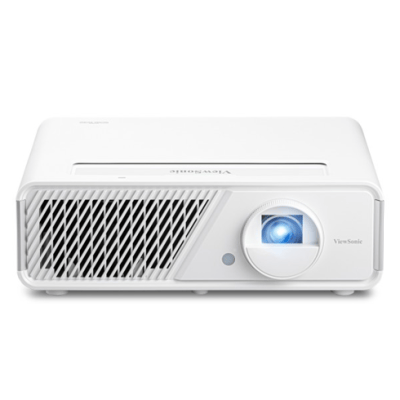
The ONOAYO is the opposite design. It is a single-panel LCD projector of roughly 10 x 7 x 12 inches with no battery at all, powered from the wall, and it puts most of its budget into sound: ONOAYO rates its two speakers at 60W combined, tuned for Dolby Audio. It adds an HDMI 2.1 input, Wi-Fi 6, an 18 ms input-lag figure for game mode and a full set of automatic setup tools (focus, keystone, obstacle avoidance and screen fitting). What it does not give you is a brightness number. ONOAYO publishes no ANSI or ISO lumen rating anywhere in the listing, only “ultra-high brightness”; the one hard figure it does publish, a 28,000:1 contrast ratio, is a manufacturer claim with no test method attached.
Amazon’s structured fields confirm that both are native 1080p (1920 x 1080). The “4K” in the ONOAYO’s title means it accepts a 4K signal and scales it down, as almost every projector at this price does.
The Netflix question
The single most practical difference is what happens when you press the Netflix button. The Capsule 3 runs Google TV and is officially licensed by Netflix, which is printed in the listing title. The ONOAYO runs its own Smart TV Pro OS 2.0, and its “Official Licensed Apps” claim covers YouTube, Prime Video and Disney+; Netflix is not among the apps it lists. For many buyers that settles it, or at least means budgeting for a $30-to-$50 streaming stick, which the ONOAYO’s HDMI port handles without trouble.
The licensing has not made the Capsule 3 trouble-free. Amazon’s AI summary of feedback from its 7,168 ratings says picture quality and size get the praise, but that app compatibility draws mixed feedback, with several owners reporting that streaming apps would not work at all. Anker appears to know this: a note added to the bottom of the listing tells buyers to update to “the latest Android 14 system software” before first use, saying the update improves streaming-app compatibility. That is worth doing on day one. It is also worth noting that soundcore’s own spec table for the same model still lists the operating system as Android TV 11.0, so the box you receive may need a sizeable update before it behaves as advertised.
The ONOAYO’s review summary, drawn from far fewer ratings (404), is more uniformly positive. Owners describe the picture as vivid on ordinary painted walls and several say it is bright enough to watch before the sun has fully set, which is a meaningful claim for a projector with no published lumen rating. They also mention that it is quiet and quick to set up. The recurring complaint is Wi-Fi: most owners have no problems, but a minority report dropped connections.
Brightness, honestly
On brightness, the Capsule 3 is the weaker machine and makes no secret of it. Two hundred ANSI lumens is enough for an 80-inch image in a dark room and not much more; owners in Amazon’s summary are split, with some calling it great and others saying it is not the best, which is roughly what 200 lumens does depending on how dark your room is. Nebula’s own comparison chart on the listing makes the point for us: its P1i, which sells for $299 on Amazon today, is rated at 380 ANSI lumens with 20W of sound, but it has no battery. Anker is charging $100 more for the Capsule 3 to make it portable, not brighter.
The ONOAYO cannot be placed on that scale at all, and that is the main reason we would hesitate to call it the better buy even at its low price. Owner reports suggest it is brighter than the Capsule 3, which would be expected from a mains-powered box several times its size, but “brighter than a battery projector” is a low bar, and without a measured figure you are taking the listing’s word for it.
Which one
If you want a projector that goes in a bag, plays Netflix natively and can run a film in the garden without a cable, the Capsule 3 at $399.99 is the only one of the two that does that, provided you install the update before you judge it. If the projector is going to live on a shelf at home and you care more about sound than about portability, the ONOAYO’s 60W speakers and HDMI 2.1 make more sense, but not at $493.99. At that price it costs more than the Capsule 3 while publishing less about itself. Wait for it to drop back under $300, which on its recent history it will, and add a streaming stick.
For more options in this range, our best projectors under $500 and best portable projectors guides cover alternatives, and our Prime Big Deal Days price check shows how small many of this week’s discounts really were.