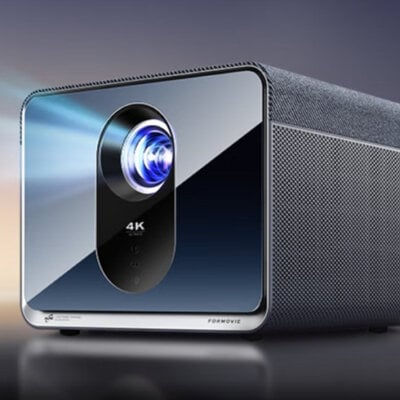
Hisense will put the L9Q Pro on sale in Germany in mid-October at a recommended price of €5,999, according to launch reports published on October 8 by Prad.de and Digital Fernsehen. The ultra short throw triple-laser projector has been on sale in the United States since late August at $5,997.97, and the European version arrives with one change American buyers will not see on the spec sheet: it runs Hisense’s own VIDAA platform rather than Google TV.
The hardware is the machine we covered at its US retail debut. Hisense rates it at 5,500 ANSI lumens, 118 percent of BT.2020 and 6,000:1 contrast, the last figure with its seven-step adaptive iris in play. It throws 80 to 200 inches from a 0.18:1 lens, adds ±5 percent vertical lens shift that the regular L9Q lacks, and supports Dolby Vision, HDR10+ and IMAX Enhanced. The 6.2.2 sound system developed with Devialet, ten drivers including two subwoofers and two up-firing channels, carries over as well. Digital Fernsehen notes that cameras handle automatic image alignment and that no screen is included in the box.
Same box, different software
Both German reports list VIDAA as the operating system, with Netflix, Prime Video, Disney+ and YouTube available through it. The US listing at ProjectorScreen describes Google TV with the Play Store and Google Assistant. So the hardware crosses the Atlantic unchanged while the software layer gets swapped, which tells you Hisense treats the platform as a regional decision rather than part of the product’s identity.
For a buyer in Munich the practical difference is smaller than it sounds. The big four streaming services are present on both. What VIDAA does not offer is the long tail of the Play Store: niche players, sideloaded tools, the Plex and Kodi setups that a certain kind of home theater owner relies on. Anyone planning to run the L9Q Pro as a pure display behind an Apple TV 4K or Nvidia Shield will not notice. Anyone who expected the built-in software to replace a streaming box should check the app list before ordering.
It also makes the US version a slightly unusual product. Most of the Google TV machines in our Google TV projector guide are portable or mid-range models; a flagship UST with the Play Store built in is rarer, and in Germany that option simply is not offered on this model.
Where the euro price really sits
A €5,999 sticker reads like a straight swap for $5,997.97, but the two numbers are not measured the same way. German retail prices include 19 percent VAT; US prices are quoted before sales tax. Strip the VAT and the German price is about €5,041. At the October 9 reference rate of roughly $1.12 to the euro, that is around $5,650 before tax, or about $350 below the American shelf price for the same projector.
That gap is the opposite of what we found when Hisense brought its lineup to Australia last month, where the tax-adjusted comparison put some models above US pricing and others well below. It is closer to the pattern we saw with Samsung’s Freestyle+ in Europe, where list prices that look identical in headline terms land differently once tax is taken out. None of this helps an American buyer directly, but it does suggest the US price is not the floor Hisense is willing to accept for this hardware.
The L9Q problem follows it across the Atlantic
The most useful line in the Prad report is not about the Pro at all. Measured against list prices, the L9Q and L9Q Pro sit €1,000 apart in Germany. But Prad notes that the regular L9Q, which launched there a little over a year ago, already sells for street prices in the low €4,000 range, which stretches the real gap well beyond the official one.
The US market is showing the same thing this week. The L9Q was $4,997.97 on Amazon in late August when the Pro first appeared. On October 9 the same listing reads $4,497.97, the price deal trackers flagged on October 8 and still in place a day after Prime Big Deal Days ended. The Pro has not moved from $5,997.97 at ProjectorScreen. The thousand-dollar step Hisense designed has become a fifteen-hundred-dollar step in practice.
What that extra money buys is the same short list on both continents: 500 more rated lumens, 8 points more color gamut, a contrast figure that depends on the iris, and a few degrees of lens shift. The bench data published for the L9Q already put that cheaper model past 6,000 lumens against a 5,000 rating, so the brightness step is the hardest one to justify. The lens shift is the most concrete. With a 0.18:1 lens, small errors in cabinet height become large errors on a 120-inch screen, and being able to nudge the image vertically without moving a 28-pound chassis is a genuine installation convenience. The iris is the open question, and our look at the PX4 Pro’s iris behavior showed how much light those contrast gains can cost.
What to watch in the next few weeks
Hisense has not said whether the German launch includes the Control4, RTI and URC integration that the US listing advertises, and those drivers are a large part of why the Pro makes sense in a custom installation. Neither German report mentions them. If they are missing, the European Pro becomes a consumer flagship rather than an integrator product, which changes who it is competing against.
The other open question is how quickly the street price drifts. Prad’s own expectation is that patient buyers will see the Pro fall the way the L9Q did. With Black Friday six weeks out and the L9Q already trading well under its list price on both sides of the Atlantic, the Pro’s €5,999 and $5,997.97 look more like starting points than settled numbers. Our L9Q Pro comparison page and the product listing will track the US price as it changes.