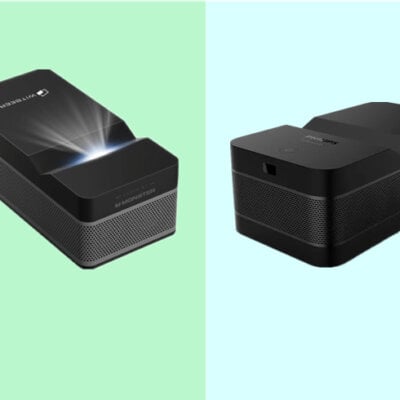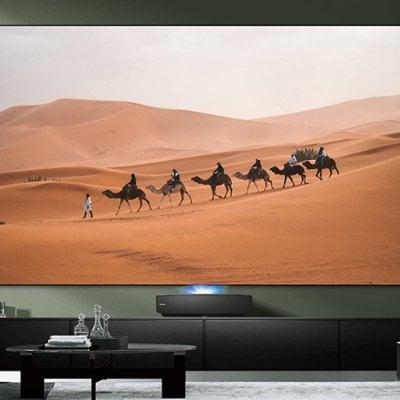
Hisense’s new flagship ultra short throw projector, the L9Q Pro, is now listed for sale at $5,997.97 with a stated 5,500 ANSI lumens and a two-to-three week lead time. The retailer carrying it, ProjectorScreen.com, also carries the L9Q it sits above. That machine is $4,997.97, the same price Amazon is asking this week.
A thousand dollars apart, then. Here is what changes.
The delta is smaller than the price gap suggests
Brightness goes from 5,000 to 5,500 ANSI lumens. Native contrast goes from 5,000:1 to a claimed 6,000:1, and the Pro adds a seven-step adjustable iris the L9Q does not have — Hisense’s own contrast figure for the Pro is quoted “with IRIS.” Color volume moves from 110 percent of BT.2020 to 118 percent. The Pro gains ±5 percent vertical lens shift, where the L9Q has none.
Almost everything else is carried straight across. Both use a 0.47-inch DMD with pixel shifting, both throw 80 to 200 inches at 0.18:1, both weigh 28.4 pounds, both run Google TV, both do Dolby Vision, HDR10+, HDR10, HLG, IMAX Enhanced and active 3D.
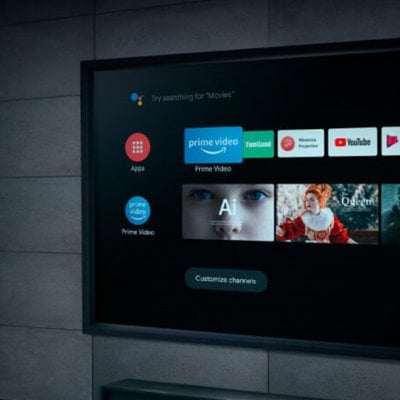
Including, notably, the audio. The Devialet system tuned with the Opéra de Paris — 6.2.2 channels, two subwoofers, up-firing drivers, 116 watts across ten speakers on the Pro’s spec sheet — is the same architecture Hisense already ships in the L9Q. The extra money does not buy a better sound system. It buys a light engine and an iris.
The bench numbers complicate the brightness claim
Here is the part worth sitting with. The same retailer that now lists the Pro at 5,500 ANSI lumens published its own measurements of the L9Q and put it “well over 6,000+ lumens” on the bench, against a 5,000 rating — roughly 200 nits on a 100-inch ALR screen. If that holds, the cheaper machine already exceeds the more expensive machine’s rated output, and the 500-lumen line item on the spec sheet is worth close to nothing in a dark room.
Contrast ran the other way in the same test. The L9Q’s rated 5,000:1 native measured somewhere around 3,000:1 to 3,500:1 depending on settings. Native contrast on a 0.47-inch DMD is a hard physical limit, and no amount of firmware moves it far. So when the Pro claims 6,000:1 with an iris in the path, the honest reading is that the iris is doing the work — closing down the beam in dark scenes to deepen black, at the cost of the brightness the brochure just advertised. That is a legitimate and widely used technique. It is not the same thing as a panel that holds 6,000:1 wide open.
This is not a Hisense-specific complaint. We went through the same exercise with the XR10, where two independent labs put a 6,000-lumen rating closer to 3,900, and the pattern in this category is consistent enough that rated ANSI figures on ultra short throw projectors should be treated as a marketing register rather than a measurement.
Timing puts it on the CEDIA floor
CEDIA Expo opens in Denver on September 1, and a flagship UST appearing at retail in the last week of August is not a coincidence. The custom-install channel is exactly where a $5,997.97 projector with lens shift, Control4, RTI and URC integration and a two-year warranty is supposed to sell. The L9Q, by contrast, has spent its commercial life as a consumer product — it is on Amazon with a 4.4-star average across 135 ratings, which is a retail profile, not a dealer profile.
Read the two products that way and the thousand dollars starts to make sense as positioning rather than as parts. The Pro adds the three things an installer asks about first: a little lens shift so the cabinet does not have to be perfect, an iris so the room can be tuned, and a control-system driver list. None of those show up in a spec comparison as value. All of them show up in a bid.
The rest of the sheet reads like a machine built for a cabinet rather than a coffee table. Four HDMI inputs, two of them 2.1 with auto low latency mode and one carrying eARC, plus USB-A, USB-C, optical out, Ethernet and a tuner. Wi-Fi 6E and Bluetooth 5.3. Laser life quoted at 25,000 hours and up, with a two-year limited warranty. At 0.18:1 the geometry is tight even by ultra short throw standards: 8.5 inches from the wall for a 120-inch image, 13.2 inches for 150, 21.1 inches for 200, with an auto screen-fit routine to square the image once the cabinet is roughly in place.
Where it lands
Against the field, $5,997.97 puts the L9Q Pro in the same bracket as the XR10 at $5,999 and above most of what we listed in our current ultra short throw guide. It also completes an unusually crowded Hisense ladder for one calendar year. The PX4 Pro arrived at $3,999 with 3,500 lumens and no Google TV, the XR10 sits at $5,999, the L9Q at $4,997.97, and now a Pro above all of them. Four flagship-adjacent USTs from one brand inside twelve months is a lot of overlapping SKUs, and the differences between them are increasingly a matter of which room they are meant to survive rather than which one has the better picture.
Hisense is the volume leader in this category and has been pricing accordingly, which is why the L9Q’s thousand-dollar discount matters: for the buyer who is not running Control4 and can place the cabinet accurately, the cheaper machine appears to give up nothing measurable on brightness and very little on color.
The buyer who should look hard at the Pro is the one with a room that fights back — ambient light on the screen wall, a cabinet that cannot sit dead center, an integrator who needs the projector to answer to a control system. For everyone else, the L9Q at $4,997.97 is the better arithmetic, at least until somebody puts the Pro on a meter and publishes what the iris actually costs in lumens.