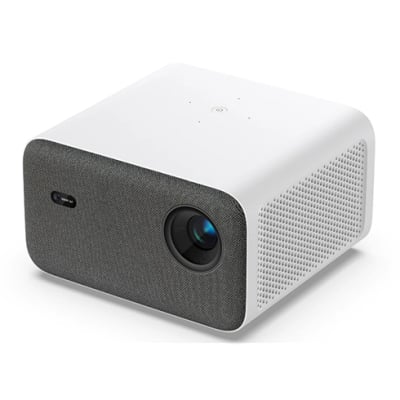
JMGO has announced the N5S Turbo, a 4K laser projector that runs at 120Hz, and it goes on sale across Chinese online stores at 8 p.m. Beijing time on Monday, October 12. The company has not put a final price on it yet. What it has said is that the Turbo is the first projector in the 8,000-yuan class to do 4K at 120Hz, using the same high-refresh architecture JMGO builds into its machines above 10,000 yuan. The announcement went out on Sunday through IT Home, and Germany’s Prad.de picked it up within hours.
The specifications come from the JD.com product page, which was still marked “coming soon” on Sunday. The Turbo uses a new laser module called QuaLas 42 and is rated at 3,600 CVIA lumens with 5,000:1 native contrast. It supports variable refresh rate for consoles and PCs, has a zoom lens covering a 0.98 to 1.4 throw ratio, and its lens shifts both horizontally and vertically, though JMGO has not published the shift percentages. It also links into Xiaomi’s Mijia smart home app, a feature JMGO has been adding to its Chinese models since the N3 generation.
That throw range is tighter than on JMGO’s bigger machines but useful in a normal room. For a 100-inch 16:9 image, which is about 2.21 meters wide, the lens needs to sit between roughly 2.17 and 3.10 meters from the wall, or about 7 to 10 feet. The N3 Ultimate, the triple-laser flagship, offers a wider 0.88 to 1.7 zoom and states its shift as up to 53 percent horizontal and 130 percent vertical.
The gap we pointed to two weeks ago
When JMGO opened U.S. preorders for the Iris Ultra at $1,899 in late September, the odd part was how the same generation was split at home. JMGO launched the N5S series in China on May 11 with four models from 5,999 to 12,999 yuan, and only the most expensive one, the N5S Ultra Max, ran 4K at 120Hz. The 9,999-yuan N5S Ultra, rated at 5,200 CVIA lumens and 9,000:1 native contrast, stopped at 60Hz. In China, 120Hz cost an extra 3,000 yuan over the next model down. In the U.S. it started at $1,899 on the Iris Ultra.
The Turbo closes part of that gap, and the trade it makes is easy to read off the spec sheet. Its 3,600 CVIA rating is below the 4,000 CVIA of the N5S Pro Max, which sold at 7,999 yuan at launch, and well below the 5,200 CVIA of the Ultra. Native contrast drops from the Ultra’s 9,000:1 to 5,000:1. In return, the Turbo gets the frame rate that neither of those models has. JMGO is betting that a Chinese buyer who plays on a PlayStation 5 or a gaming PC would rather have 4K at 120Hz than another 1,600 lumens, and it is the first time it has put that choice below the flagship price in its home market.
The rough numbers support the bet. If the Turbo lands at around 8,000 yuan, that is about $1,060 at Monday’s rate of 6.70 yuan to the dollar once China’s 13 percent VAT is taken out. That would put it roughly $840 below the Iris Ultra’s U.S. preorder price, which is quoted before sales tax. The two are not the same machine. The Iris Ultra carries a triple-laser engine rated at 4,500 ISO lumens and 7,000:1 native contrast, and a CVIA figure has to meet color-accuracy conditions an ISO figure does not, so the two ratings cannot be compared directly. Still, if the price lands where JMGO says, the cost of 4K at 120Hz in a JMGO projector has fallen by more than a third in China in five months.
What JMGO has not said
Several things a buyer would want to know are missing from both the announcement and the JD listing as it stood on Sunday. There is no input lag figure at 4K/120 or at any other mode. JMGO has not said whether QuaLas 42 is a triple-laser source like the Ultra models’ light engine or a hybrid laser, and the name does not settle it. The listing does not say how many HDMI 2.1 ports the Turbo has, which matters for anyone running a console and a soundbar together, and it does not list the DMD size or the operating system.
There is also no word on a Turbo for other markets. JMGO did not mention an overseas launch when it announced the model, and nothing resembling it appears on the brand’s U.S. or European stores. That matches how the company has handled the N5S generation so far. The international lineup, the Iris Ultra and the Iris Ultra Max at $2,999, was built around 4K/120 from the start, while the Chinese lineup was built around brightness tiers. The Turbo looks like JMGO adding a gaming model at home rather than a cheaper version for export.
A crowded week for 120Hz
JMGO’s timing is not an accident. XGIMI put the AURA 3 on sale in China at the end of September and billed it as the first native 4K/120Hz laser TV, at 18,999 yuan for a 100-inch bundle. XGIMI has also said its HORIZON 30 Pro, 30 Max and 30 Ultra Max open for preorders in the United States on the same day the Turbo goes on sale in China. All three are described as triple-laser models with 4K at 120Hz and a dual iris, and XGIMI has not published their prices or full specifications ahead of launch.
By the end of this week, 4K at 120Hz should be on sale or on preorder from both JMGO and XGIMI at several price points, on both sides of the Pacific. For JMGO, the question Monday night’s price tag will answer is whether “8,000-yuan class” means 7,999 or something closer to the Ultra. The question for buyers will take longer: whether 3,600 CVIA lumens is enough light for a living room once the novelty of 120 frames per second wears off.