Epson finished fourth in Japan’s projector market in August, its second consecutive month outside the top three. Anker led on unit share with 19.2 percent. Aladdin X and XGIMI tied behind it at 17.3 percent each. Epson took 16.4 percent. The numbers come from BCN Ranking, which aggregates actual sell-through at roughly 2,400 electronics and camera chains and online shops across Japan, and were published on 13 September by BCN analyst Ichiro Michikoshi, who called the reshuffle an “incident” in a category that had been settled for years.
The gap is small — three points separate first from fourth — but the composition of the table has changed completely. For most of the past decade the Japanese chart was Epson at the top with Anker chasing it. It is now four brands in a heap, and three of them sell something Epson mostly does not.
The category is growing, not collapsing
None of this is a story about projectors losing to televisions. August unit sales came to 149.1 percent of the year-earlier month and revenue to 157.9 percent — growth of roughly 49 and 58 percent. Units have been up year on year for eleven straight months, since October 2025; revenue for six straight months, since March. Going back to August 2024, the category posted double-digit unit growth in twelve of those months and double-digit revenue growth in sixteen, against four down months on units and three on revenue, every one of them a single-digit decline.
The average selling price is holding in the ¥80,000 range before tax, about $520. That is a market where volume and price are rising together, which almost never happens in Japanese consumer electronics and is the clearest signal that buyers are not trading down.
What the top three actually sell
Anker’s position rests almost entirely on the Nebula Capsule line — the soda-can-shaped body with a battery, Wi-Fi and speakers inside, which did more than any other product to establish the idea that a projector should finish a movie without anything else plugged into it. The volume model is still the Capsule 3, launched in 2024, running Google TV at 1080p and 200 lumens. It has stayed Anker’s best seller in Japan even after the cheaper Capsule Air arrived under it.
Aladdin X is best known for the Aladdin X3, the projector that screws into a ceiling light socket, but its earner is the Aladdin Poca — a cylinder that looks a lot like the Capsule, rated at 450 lumens, with a tilting foot so it can be aimed, and running the company’s own Aladdin OS rather than Google’s. It sells for the low ¥50,000s before tax, roughly the same as a Capsule 3.
XGIMI is at the other end of the price range. Its best seller in Japan is the HORIZON 20 Pro, an RGB triple-laser machine rated at 4,100 lumens with 240Hz support and a claimed 1ms input lag, carrying an average selling price near ¥200,000 — about $1,300. Underneath it the company also fields the Nova Cloud Ash at around ¥30,000. Wide coverage, both ends of the shelf.
Second and third place are the same company
Aladdin X started life as popIn, the Tokyo studio that crowdfunded the original popIn Aladdin ceiling-light projector and turned it into a domestic hit. XGIMI bought the business in 2022. Counted as one group, XGIMI and Aladdin X hold 34.6 percent of August units, more than double Epson’s 16.4 — a rather different picture than a four-way tie. It also lands in a year when XGIMI’s overseas revenue nearly doubled while its Chinese business shrank, and Japan is a large part of what “overseas” means for that company.
The queue behind them keeps lengthening, too. Dangbei brought the N3 Max to Japan in August at ¥89,900, the first projector sold there running VIDAA, with licensed Netflix on board out of the box, 1,000 ISO lumens, automatic focus and keystone and 12W of Dolby Audio. On the metric that is deciding this chart — what the box can do on its own — it is aimed squarely at the shelf Anker and Aladdin X are winning.
Epson’s best seller is a meeting-room projector
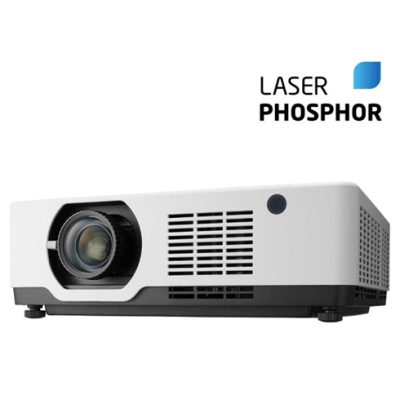
The clearest explanation for fourth place is on Epson’s own shelf. Its top-selling projector in Japan is the EB-W55: 3LCD, WXGA 1280×800, 4,000 lumens, a lamp rated to about 12,000 hours, a 2W speaker, 2.6kg, around ¥80,000. It is a competent and sensibly priced meeting-room machine, and it cannot play anything by itself. Plug a laptop in or it shows you a blue screen.
Epson does build the other kind of product. The Lifestudio Flex EF-72 is a 3LCD lifestyle projector, 4K, 1,000 lumens, on a mount that tilts 105 degrees and swings 180, doubling as coloured ambient lighting when it is not projecting, at ¥179,899 direct. Michikoshi’s reading is that it is not selling. It is not hard to see why: at that price it sits against the HORIZON 20 Pro and concedes 3,100 lumens to it. Our 2026 guide to the Epson line-up runs into the same wall from the US side — the company’s strongest arguments are all in home-theatre and installation hardware, not in the box people put on a shelf for $300 to $600.
Michikoshi closes his column by pointing back to 2005, when Epson sold a great many units of a projector called the dreamio EMP-TWD1 with a DVD player and speakers built into it — the same idea as everything winning today, twenty years early and then let go.
Two things the table does not say
BCN Ranking measures retail sell-through. It sees consumer-electronics chains, camera chains and online shops; it does not see the dealer and integrator channel through which classrooms, offices, rental houses and venues buy, and that channel has always carried the bulk of Epson’s projector volume. Fourth place on a consumer shelf is a statement about one counter, not about a company.
The second is supply. Epson builds the 3LCD panels, and 3LCD is still the imaging technology inside a large share of the projectors sold worldwide, plenty of them wearing someone else’s badge. Several of the components underneath this market are consolidating in ways that never show up on a brand chart — the LCoS smart-projector silicon that changed hands in January is the current example. Brand share and technology share are two different scoreboards.
Still, the number worth sitting with is this one. The projector selling best for the brand that now leads Japan is rated at 200 lumens. The projector selling best for the brand in fourth is rated at 4,000. Whatever Japanese buyers are deciding on, it stopped being brightness some time ago.