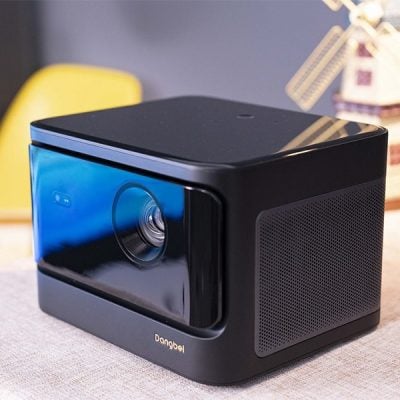
Dangbei began taking reservations on Sunday for a new home projector called the X9 Max, rated at 4,800 CVIA lumens and fitted with an optical lens shift assembly, and did not say what it costs. The machine goes on sale in China on Wednesday, 16 September, at 10am Beijing time, and the price arrives with it.
Selling a flagship on a spec sheet for two days before anyone can see the number attached to it is ordinary practice in the Chinese projector market, where the launch-morning discount is the event. What is not ordinary is the spec sheet. The X9 Max is not the brightest projector Dangbei makes and it is not the most expensive one either. It is the one that can move its lens.
What is on the sheet
Rated output is 4,800 CVIA lumens, which Dangbei also expresses as 5,000 ISO lumens. The light source is a new generation of the company’s in-house laser module, badged QuaLas42, up from the QuaLas32 in the X7 series. Dynamic contrast is quoted at 80,000:1. The image is 4K, and Dolby Vision, Dolby Audio and DTS:X are all listed.
Processing runs on MediaTek’s MT9681, the same chip inside Dangbei’s 15,999-yuan S7 Ultra Max. Gaming gets a variable refresh rate and a claimed 1ms of input lag. The software is Dangbei’s Super AIOS 6.0 with the company’s own large language model wired into search and setup.
The optics are where the announcement spends its effort: a 1.2-1.5:1 optical zoom, a lens Dangbei calls 99.6 percent transmissive, and a four-way lens shift with a stated range of plus or minus 135 percent vertically and plus or minus 50 percent horizontally.
Those two percentages settle an argument
Dangbei had been teasing a “four-way lossless” feature for days without explaining it, and Chinese enthusiast forums spent the wait arguing over what the phrase covered. The suspicion was fair. “Lossless” is the word Chinese projector marketing usually attaches to digital keystone correction that crops fewer pixels than the competition, not to a lens group that physically travels inside the chassis. A widely read post on the shopping community Smzdm laid out three things to check on launch day, the first being whether Dangbei would publish a plus-or-minus range at all.
It did, and that resolves it. A shift specification written as a percentage of image height and width only means anything if the lens assembly is being translated mechanically, because the figure describes how far the projected rectangle travels relative to its own size. Digital keystone has no equivalent number. Plus or minus 135 percent vertical is a wide range by any standard, and it is what decides whether a projector can sit on a low side table without the image folding into a trapezoid.
Dangbei’s brightest projector cannot do this
Read Dangbei’s own store listings and the split is plain. The S7 Ultra Max, the company’s flagship at 15,999 yuan against a 20,999-yuan list price, is rated 5,800 CVIA lumens and sold on what Dangbei calls cinema-grade optical zoom. Lens shift is not among the features it leads with. The S7 Ultra Pro below it is rated 5,300 CVIA. Both are brighter than the X9 Max.
The X7 Ultra, at 10,499 yuan from a 13,499-yuan list, is rated 3,800 CVIA lumens, and its store page leads with exactly two optical claims: super lossless optical zoom, and four-way lossless optical lens shift. That is 1,000 CVIA lumens below the new machine.
So the X9 Max drops into a gap Dangbei left open. Between the X7 Ultra’s 3,800 CVIA and the S7 Ultra Pro’s 5,300 there was nothing, and the new projector lands in the middle of it carrying X-series optics rather than S-series brightness. Brightness and placement freedom have become two separate ladders in this catalogue, and a buyer now has to decide which one they are climbing. The model number skips a rung too, going straight from X7 to X9 with no X8 in between.
Why there are two brightness numbers
The 4,800 CVIA and 5,000 ISO figures describe one machine measured two ways. CVIA lumens come from a Chinese industry standard published in April 2023 by the China Video Industry Association, drawn up after a sampling test the previous autumn found brightness labelling across the category to be badly inconsistent. The standard adds colour temperature and colour coordinate requirements the older ANSI method leaves unspecified, and it requires measured output to reach at least 80 percent of whatever the box claims.
Dangbei helped write it. So did Xiaomi, XGIMI, JMGO and Hisense, among a dozen or so manufacturers and platform operators. Which makes the next line on the X9 Max spec sheet more interesting than it first looks.
It answers to Xiaomi’s voice assistant
The X9 Max is listed as interoperable with Mi Home, Xiaomi’s smart-home platform, and controllable through Xiao Ai, Xiaomi’s voice assistant. Xiaomi sells projectors of its own under the Mijia and Redmi names, in the same price bands this machine is aimed at.
Dangbei owners have wanted this for a long time and have been getting it the hard way, through third-party bridges and infrared relays that Chinese forums have documented in step-by-step guides across at least two product generations. Building it in is a small feature with a large implication. In a market where the smart-home platform is increasingly what keeps a household loyal to a brand, Dangbei has decided it would rather be reachable inside a rival’s ecosystem than hold out for its own.
None of this reaches American buyers
Dangbei’s US catalogue tops out at the MP1 Max, a 4K triple-laser model rated 3,100 ISO lumens and currently 1,599 dollars against a 1,999-dollar list. The DBOX02 Pro sits under it at 2,000 ISO lumens and 1,199 dollars. A 5,000 ISO machine would be more than half again as bright as anything Dangbei ships to the United States, and no US model offers optical lens shift at all.
The export line has been moving the other way, toward small and cheap. The N3 Max, 1,000 ISO lumens and 399.99 dollars on Amazon, is the model Dangbei has pushed hardest in the States this year; it is bright enough for a 100-inch image in a darkened room, runs licensed Netflix out of the box rather than through a dongle, focuses and squares itself automatically, and takes a mains cable instead of a battery. The Japanese launch of the same machine in August followed the identical playbook.
Whether the X9 Max ever crosses over is a question about margins rather than engineering. Dangbei’s half-year numbers and those of its closest competitor point the same way: XGIMI’s overseas sales nearly doubled in the first half of 2026 while its Chinese business shrank about 30 percent. The bright, expensive, lens-shifting machines stay home. The portable ones get passports.
The figure worth watching on Wednesday is where the X9 Max lands against the X7 Ultra’s 10,499 yuan. Below it, and Dangbei has quietly turned optical lens shift into a mid-range feature in China while the rest of the world still pays home-cinema prices for it. Above it, and the X9 Max is the S-series brightness ladder with a lens that moves, priced to match.