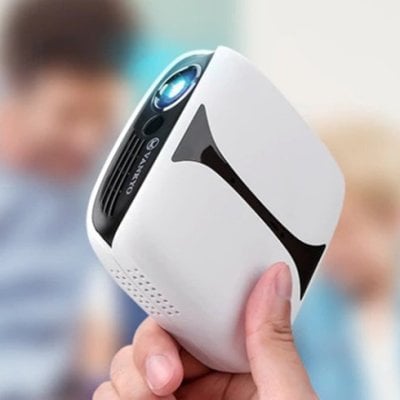
Aurzen has opened preorders for the ZIP Pro, the Full HD successor to its tri-fold pocket projector, at $579.99 in the US, UK and EU. The price is an early-bird rate that runs until October 15; after that the projector lists at $629.99, and Aurzen says shipping starts October 30. A bundle with the company’s CastPlay Pro USB-C wireless dongle is $629.99 during the same window.
The ZIP Pro was first shown at IFA in Berlin this month. It keeps the Z-shaped hinge that let the original fold flat and stand itself up without a tripod, but almost everything inside the hinge has changed.
What moved on the spec sheet
The imaging chip goes from native 720p to native 1920 x 1080 DLP, and rated brightness goes from 100 to 200 ANSI lumens. Aurzen says the optical engine is 10.7 mm thick. The battery is now two 5,000mAh cells, rated at 38Wh in total, where the first ZIP had a single 5,000mAh cell. Aurzen rates it for 150 minutes in Eco mode, up from 90 minutes. Charging is 65W USB-C PD, up from 24W, and with a 65W-or-better power bank you can watch while it charges. Aurzen says a lower-wattage bank will run the projector but won’t charge it at the same time.
The bigger functional change is a second USB-C port that accepts video. Phones, tablets and laptops that output DisplayPort over USB-C can now plug straight in instead of relying on wireless mirroring, and Aurzen lists the Nintendo Switch, Steam Deck and Lenovo Legion Go 2 as compatible. It quotes 20-40 ms of input lag in its low-latency game mode over that wired connection. Wireless options are AirPlay, Miracast, DLNA, Google Cast and Aurzen’s own AirLink peer-to-peer mode. The speakers go from 1W to 2W per side, the ZIP Pro can send audio to two Bluetooth headphones at once, and a small touch display on top shows battery level and connection status.
Throw ratio changes from 1.09:1 to 1.2:1. Maximum image size is 115 inches, but Aurzen itself suggests 60 to 80 inches in a dark room. Rated fan noise is 24 dB in Eco mode, 28 dB in Normal and 35 dB in the conference mode. The product page lists native contrast as 300:1.
The fold got bigger too
Aurzen’s own two product pages make the trade easy to work out. The original ZIP measures 84 x 78 x 26 mm and weighs 280 g. The ZIP Pro measures 115 x 97 x 44 mm and weighs 586 g. That is about 170 cubic centimetres against 491, so the new model takes up 2.9 times the space and weighs 2.1 times as much, for twice the rated brightness and 2.25 times the pixels. It no longer fits in a jeans pocket, though a jacket pocket or a small sling bag would still work. Aurzen’s copy still calls it “pocket-size”. As New Atlas put it, the label is now doing a little more work.
The battery numbers make sense once the brightness is included. Capacity doubles, but the projector also puts out twice the light, so a 67 percent longer Eco-mode runtime is a reasonable result, not a disappointing one. Eco mode will be dimmer than 200 lumens, though, and Aurzen doesn’t publish a runtime at full brightness. With 150 minutes you can finish most films in Eco mode, but probably not at full output.
The slightly longer throw also costs some space. At 1.2:1, an 80-inch 16:9 image needs the lens about 2.1 metres from the wall, compared with roughly 1.9 metres for the original. In a hotel room or a tent that difference can decide which wall you use.
Where $580 lands
The price gap is the bigger story. Aurzen now sells the original ZIP on its own store for $259.99, marked down from a $499.99 list price. The Pro is 2.2 times that price. Per rated lumen the two are close ($2.90 against $2.60), but the ZIP Pro isn’t priced as a budget pocket projector. You’re paying for the fold, the Full HD chip and the USB-C video input together.
It also has no streaming system. The ZIP Pro is a display that expects a phone, a console or a stick to supply the picture, like its predecessor. That matters because the big subscription apps usually block screen mirroring. Aurzen’s own FAQ for the first ZIP says a streaming accessory is the smoother route for Netflix or Disney+, and that is why the $629.99 bundle adds the CastPlay Pro dongle.
That gives shoppers a different comparison than the spec sheet suggests. If the projector will mostly be used indoors, on a nightstand or carried between rooms, $399.99 currently buys the Dangbei N3 Max on Amazon. It is rated at 1,000 ISO lumens, five times the ZIP Pro’s figure. It runs VIDAA with a licensed Netflix app built in, has automatic focus and keystone plus 12W Dolby Audio speakers, and it’s $180 cheaper than the ZIP Pro’s early-bird price. It isn’t foldable and it isn’t battery powered, so it doesn’t compete with the ZIP Pro for a backpack. But a lot of people who buy “portable” projectors mostly move them from the living room to the bedroom, and they get far more light and native streaming for less money.
The ZIP Pro targets the other kind of buyer: someone who needs a projector that fits in a carry-on, runs a Switch from one USB-C cable, and can be stuck to a ceiling with Aurzen’s magnetic mount. For that buyer, the main question is whether 200 lumens is enough for a 60-inch picture in a dim room. It is the right number for this size of projector, and doubling the original is a real improvement, not a spec-sheet trick. Aurzen’s rating is still an in-house figure, though. Nobody outside the company has measured the Pro yet, and reviewers will get that chance once units ship at the end of October. The pico projectors we currently recommend will give the Pro plenty of competition when those tests come in