Almost any projector will show an iPhone screen if you add enough adapters, apps and patience. The ones worth recommending to an iPhone owner are the ones that don’t need any of that. In practice, that comes down to which of three connection routes the projector supports, not how bright or sharp it is. This guide sorts the current field by that question first. Prices are the Amazon or manufacturer prices we checked in late September 2026.
Three ways an iPhone gets onto a wall
Native AirPlay. The projector’s own operating system accepts AirPlay, so you tap the Screen Mirroring icon in Control Center, or the AirPlay icon in a video app, and the picture appears. You don’t install anything or make an account. Samsung’s Tizen, LG’s webOS and the VIDAA system used by Hisense and Dangbei all include it. Google TV doesn’t: it uses Google Cast, which works from YouTube and a lot of iPhone apps but can’t mirror the iPhone screen.
A USB-C cable. The iPhone 15 and later can send video over USB-C. If the projector has a USB-C port that accepts video (DisplayPort Alt Mode), one cable does the job with no Wi-Fi, no lag from wireless compression and no pairing. Few projectors have this port. Most USB-C ports on projectors only charge the projector.
An app or an adapter. Everything else. Google TV projectors can mirror an iPhone through third-party receiver apps, and any projector with HDMI works with Apple’s USB-C or Lightning digital AV adapter. It works, but it’s the route people give up on.
Netflix affects all three. The Netflix iPhone app doesn’t support AirPlay and hasn’t since April 2019, so even a perfect AirPlay projector won’t take a Netflix stream from your phone. For Netflix, the projector needs its own licensed app. That’s the second thing we checked for every pick below.
Best overall for iPhone: Dangbei N3 Max ($399.99)
The N3 Max runs VIDAA, and Dangbei’s own product notes list Apple AirPlay alongside a licensed Netflix app, Prime Video, Disney+, YouTube and Apple TV+. That covers both halves of the iPhone problem: photos, home videos and most apps go over AirPlay, and Netflix plays natively on the projector.
It is also the brightest projector here for the money, at 1,000 ISO lumens for $399.99 on Amazon this month. That’s more than four times the Samsung Freestyle 2nd Gen’s rating for about the same price. Automatic focus and keystone correction mean you can put it on a shelf, point it at a wall and get a square picture without the remote. The 12W Dolby Audio speakers (two 6W drivers) are good enough for a bedroom or small living room without a soundbar. It has no battery, so it isn’t a camping projector. For iPhone users who watch indoors, it’s the easiest recommendation in this guide. We compared it with its closest rival in N3 Max vs Nebula P1i.
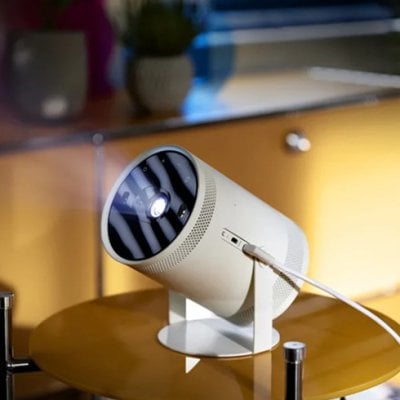
The portable with AirPlay 2: Samsung The Freestyle 2nd Gen ($383.99)
Samsung’s cylinder projector runs Tizen, the same system as Samsung TVs, so it has AirPlay 2 and a built-in Netflix app. The discount has made it much more reasonable: Amazon had it at $383.99 this week, against the $799.99 Samsung lists. With 453 ratings averaging 4.2 stars, owners are mostly happy.
The limitations are brightness and power. ProjectorCentral lists it at 230 ANSI lumens, which means a dark room and a picture under 80 inches. It has no internal battery. Samsung sells a Battery Base separately, or you can run it from a USB-C power bank that delivers 50W. Its USB-C port is for power, not video. The swivel cradle is the real reason to buy it, since it can point at the ceiling with no stand. If you want more brightness in the same design, the new Freestyle+ is rated at 430 ISO lumens and was $1,047.95 on Amazon this week.
The one that takes a cable: BenQ GV50 ($638.99)
The GV50 is here because of one port. BenQ’s spec sheet lists its USB-C as DisplayPort / PD in, so an iPhone 15 or newer can plug straight in with a USB-C cable. It’s the most reliable connection in this guide, and useful anywhere the Wi-Fi is bad, such as hotel rooms, tents or a friend’s garage. It also has a battery that reviewers put at around two and a half hours, 500 ANSI lumens of rated brightness and Google TV with a certified Netflix app.
Wireless is weaker. Google TV has no AirPlay, and BenQ’s own support page tells iPhone owners to install a separate screen-sharing app before they can mirror. So the GV50 is the cable pick. With a cable it works well; without one it’s harder to use from an iPhone. It was $638.99 on Amazon at the time of writing, with a 4.1-star average from 148 ratings.
For a real home theater: Hisense M2 Pro ($1,297.99)
For a bigger picture with no compromises on the iPhone side, the M2 Pro is the one to get. Hisense’s product page lists “Screen Mirroring: Airplay2, Miracast” under VIDAA, along with 1,300 ANSI lumens from a triple-laser engine, 4K resolution and Dolby Vision. Netflix is built in. It’s compact enough to carry between rooms, and at $1,297.99 on Amazon it costs more than three times as much as the N3 Max. The extra money buys brightness and color for a 100-inch picture; the iPhone experience is the same.
Hisense’s C2 family would also belong here on specs, since it has the same VIDAA system with AirPlay 2 listed. But the C2 was showing as unavailable on Amazon when we checked, and the C2 Pro is $1,699.99 on Hisense’s store. The M2 Pro is the easier one to buy right now.
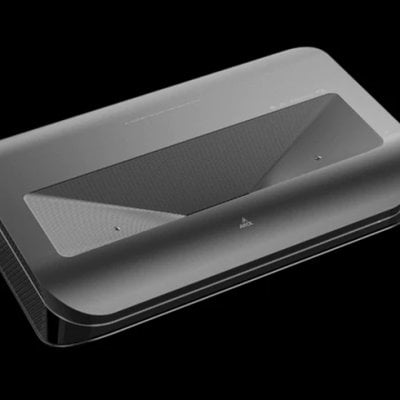
Ultra short throw with both routes: LG CineBeam S ($1,299.99)
LG’s small ultra-short-throw projector is the only model here that has both native AirPlay 2 and USB-C video. LG’s spec sheet lists AirPlay 2 up to 4K at 30Hz, and two USB-C ports marked for display and charging. It runs webOS with Netflix built in and is rated at 500 ANSI lumens. Because it sits a few inches from the wall, it works in rooms where there’s nowhere to put a normal projector.
We’re less sure about this one. At $1,299.99 it has a 3.4-star average from 34 Amazon ratings, which is low for a projector at this price, and 500 lumens across a large ultra-short-throw image doesn’t leave much headroom in a bright room. LG’s other compact AirPlay projector, the CineBeam Q (HU710PB), is now marked discontinued on LG’s US site, so treat any remaining stock as clearance, not a current model.
For a travel bag: Aurzen ZIP ($259.99)
The tri-fold ZIP is the smallest projector here. It weighs 280 g and folds to 84 x 78 x 26 mm. It creates its own peer-to-peer connection, so an iPhone can mirror to it with no Wi-Fi network, on a plane, in a tent or in a hotel room with a captive portal. At 720p and 100 ANSI lumens it’s a dark-room projector for 40- to 60-inch pictures. Aurzen’s own blog warns that mirroring Netflix, Disney+ or Prime Video produces an HDCP error, so it’s for your own videos, downloads, YouTube and games, not subscription streaming. Aurzen currently sells it for $259.99 on its own store. The new 1080p ZIP Pro adds a USB-C video input, but it costs $579.99 and doesn’t ship until October 30.
What we left out, and why
Several of our favourite portables aren’t here. The XGIMI MoGo 4, Dangbei Freedo and Anker’s Nebula Capsule Air and Mars 3 Air are all good projectors, and all of them run Google TV with licensed Netflix. None of them has native AirPlay on its official spec page, and none takes video over USB-C. Anker’s own support page sends iPhone owners to a separate app and says DRM-protected services won’t mirror through it. If you own an Android phone or only stream from the projector’s own apps, look at our best portable projectors for 2026 instead. If you have an iPhone and want to show photos from last weekend without thinking about it, stick to the list above. For most people that means the N3 Max, unless the projector needs to fit in a jacket pocket or plug into a USB-C cable.