A business projector is bought for one reason: the room has windows, or lights that nobody is allowed to turn off, and the picture has to survive both. Everything else is secondary. That is why this corner of the market looks nothing like the consumer one, and why a 4,000-lumen meeting-room machine can cost less than a 700-lumen portable with a battery and a streaming stack.
Six machines are below, all checked against their manufacturers’ own specification sheets and priced at what Amazon was charging on 15 September 2026. They run from 340 dollars to a thousand. Between them they cover a small huddle room, a training room with daylight, and a hall where the lamp needs to stop being somebody’s job.
BenQ MW560C, 339.99 dollars
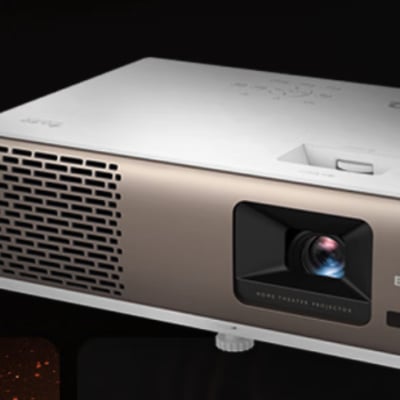
The cheapest way into 4,000 ANSI lumens with a warranty and a support line behind it. WXGA, 1280 x 800, DLP, 20,000:1 contrast, two HDMI inputs and a 15-pin VGA for the conference-room laptop that still has one. Throw ratio is 1.55 to 1.7:1, so a 100-inch image wants around 12 feet of room, and the zoom is only 1.1x, meaning placement is close to fixed once the mount goes in.
BenQ quotes 6,000 hours of lamp life in normal mode, 10,000 in Eco and SmartEco, and 15,000 in LampSave. Those numbers are not interchangeable, and the last one is the mode where the picture is dimmest.
The reason it leads this list is a price oddity. The projector it replaces, the plain MW560, is still on Amazon at 625 dollars with the same 4,000 ANSI lumens, the same WXGA panel, the same 20,000:1 and the same 1.55 to 1.7 throw. The newer model is 285 dollars cheaper than the older one, on the same retailer, on the same day. If your shortlist has the MW560 on it, take the C.
Epson PowerLite 119W, 489.00 dollars
The 3LCD answer, and the one to pick if what goes on screen is slides, spreadsheets and logos rather than video. Epson rates it at 4,000 lumens of white brightness and 4,000 lumens of colour brightness, which is the whole argument for a three-chip engine: a single-chip DLP quotes one number and delivers less colour output than white, so saturated corporate blues and reds land softer than the spec suggests.
WXGA at 1280 x 800, 16,000:1 contrast, 1.2x zoom on a 1.30 to 1.56:1 throw, dual HDMI plus VGA, USB-A, USB-B, RS-232c and RJ-45 for network management, which matters when a facilities team is looking after twenty rooms. A 16W speaker and a microphone input, which is more audio than anything else here. It weighs 6.17 pounds.
Lamp life is 8,000 hours normal, 10,000 medium, 17,000 in Eco: the longest normal-mode figure on this list by a wide margin. Epson’s own MSRP is 685 dollars, so the Amazon price is a real discount rather than a list-price fiction.
Optoma EH412, 591.00 dollars
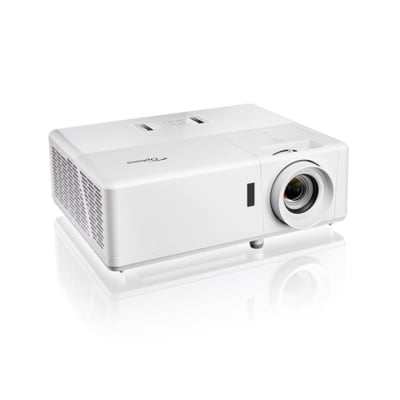
The brightness pick among the lamp machines: 4,500 ANSI lumens at native 1920 x 1080, with 50,000:1 dynamic contrast and an HDMI 2.0 input that accepts a 4K HDR signal and downscales it. For a training room where someone will inevitably plug in a laptop running a 4K video, that input matters more than it sounds.
The throw is 1.12 to 1.47:1 with a 1.3x manual zoom, the widest placement latitude of the lamp-based options here, and keystone runs to plus or minus 40 degrees vertically.
Read the lamp figure carefully. Optoma’s headline is 15,000 hours; the mode table underneath says 4,000 hours in Bright, 10,000 in Eco, 12,000 in Dynamic and 15,000 in Eco Plus. A projector bought for 4,500 lumens will be run in the mode that gives 4,000 hours. That is still five years at four hours a day, but it is not fifteen thousand.
ViewSonic PA503HD, 640.00 dollars
Native 1080p on a 0.65-inch DMD, 4,000 ANSI lumens, 22,000:1 contrast, dual HDMI and a USB-A port with enough current to run a wireless HDMI dongle off the projector itself, which removes a power brick from the ceiling. Throw ratio is 1.48 to 1.62:1 with 1.1x optical zoom and 40 degrees of vertical keystone; ViewSonic publishes the distances plainly, with a 100-inch image landing at 10.8 feet.
Lamp life is 4,000 hours standard and up to 15,000 in SuperEco. It is the most conventional machine here and the one with the least to explain, which in a shared meeting room is a virtue.
ViewSonic LS740HD, 999.99 dollars
The only lamp-free option on the list, and the reason to spend the extra: a third-generation laser phosphor engine rated for 30,000 hours, against 4,000 to 6,000 hours of normal-mode lamp life on everything above it. At five hours a day that is sixteen years before the light source is the problem, and nobody has to own a spare-lamp budget line.
Full HD 1080p, a 1.13 to 1.47:1 throw with 1.3x optical zoom, images to 300 inches, four-corner adjustment, 360-degree projection and portrait mode for installations that are not a rectangle on a wall. It is 6.6 pounds and 11.3 by 5.0 by 8.5 inches, which is small for what it does.
One number needs care. The Amazon listing title says 5,500 lumens. ViewSonic’s own product page and datasheet call it a 5,000 ANSI lumen projector, and so does B and H. Buy it as a 5,000 ANSI lumen machine and it is an easy recommendation; the extra 500 exists only in the shopping listing. This is a recurring habit in projector retail rather than a ViewSonic quirk, and we went through a sharper example of it on the consumer side today.
BenQ MW560, 625.00 dollars
Included for completeness, because it is still one of the most-reviewed business projectors on Amazon with 123 ratings at 4.4 stars, and because a buyer comparing specification sheets will land on it. Four thousand ANSI lumens, WXGA, 20,000:1, dual HDMI plus VGA, a single 10W speaker, 2.3kg, 260W draw, 6,000-hour normal lamp life rising to 15,000 in LampSave.
Everything in that paragraph is also true of the MW560C at 339.99. Unless a procurement list names this exact model number, there is no case for paying the difference.
Two things to check before you buy any of them
The first is the lamp-hour asterisk. Every lamp machine here publishes its longest figure as the headline and its shortest as a footnote, and the gap is not small: 6,000 against 15,000 on the BenQs, 4,000 against 15,000 on the Optoma and the ViewSonic PA503HD. The eco modes that produce the long numbers cut brightness, which is the thing you bought the projector for. Budget lamps on the normal-mode figure, and if the room is used daily, the laser machine’s total cost starts looking different.
The second is white brightness against colour brightness. Single-chip DLP projectors quote one lumen figure, measured white. Three-chip 3LCD projectors like the Epson quote two, and match them. In a room with the lights on, showing slides full of brand colour, the difference is visible in a way that a spec sheet comparison of two identical 4,000-lumen numbers does not capture. This is not a reason to avoid DLP, which has the sharper text and the better contrast here; it is a reason to see both before signing off on twenty rooms.
What is not on this list is anything with a smart operating system or a streaming app, and that is deliberate. A projector attached to a meeting-room network does not want an app store on it, and every model above boots to an input rather than a home screen. If the requirement is a machine that streams, that is a different category and a different piece: our guide to the best laser projectors for 2026 covers the consumer laser machines, and the short throw guide handles rooms where the projector has to sit close to the wall.
Prices move. All six figures above are what Amazon charged on 15 September 2026, checked individually rather than taken from a listing cache, and the BenQ pair in particular is the kind of gap that will not survive a clearance.