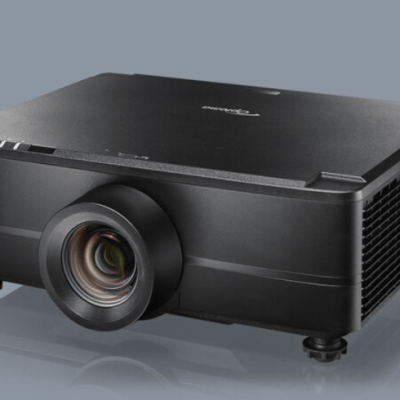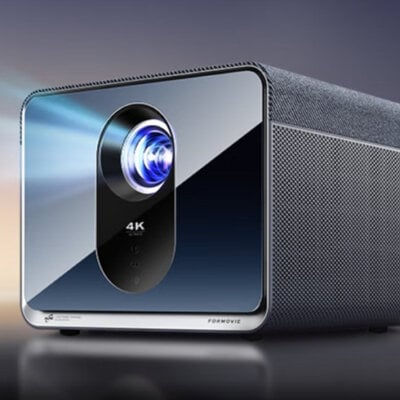
BenQ on October 1 announced U.S. pricing for two new golf simulator projectors, the 6,000-lumen AK900ST at $5,999 and the 5,000-lumen AK800ST at $3,999, with sales through BenQ.com and authorized resellers starting later this month. Both are native 4K short-throw laser models, and both arrive about a month after BenQ first showed them in Europe on August 31.
The company is pitching the pair as golf-first machines that also double as the home theater. A BenQ-commissioned survey of 500 U.S. respondents, cited in the launch release, found two-thirds of simulator owners also use the room for movies, sports or gaming.
What the two models share
On BenQ’s U.S. spec sheets, both projectors list 97% Rec. 709 coverage, a 3,000,000:1 FOFO contrast figure, HDR10 support, a laser rated for 20,000 hours in normal mode and 30,000 in Eco, and three HDMI inputs on the 2.1 standard. Input lag is listed at 18.1 ms for 4K at 60Hz, 9.7 ms at 1080p/120Hz and 4.8 ms at 1080p/240Hz. Both carry a camera-based Auto Screen Fit 2.0 system that reads flat or curved impact screens and corrects geometry, plus autofocus, an ambient light sensor and a revised Golf Mode 2.0 that BenQ says uses frame-based AI processing to adjust color and contrast.
New screen-fill presets add 5:4 and 3:2 to the 1:1 and 4:3 shapes simulator owners already use. Scene Memory stores separate settings for golf, movies, games and sports, and a 24p Cinematic Mode handles film playback.
Two models, two old lenses
The more useful way to read the launch is against what BenQ already sells, because each new model shares its optics with an existing one.
The AK900ST lists a 0.81-0.89 throw ratio, a 1.1x zoom, an F1.83-1.86 aperture and lens shift of plus or minus 60% vertical and 23% horizontal. Every one of those figures matches the LK936ST, BenQ’s current install-grade golf projector, which sold for $4,799.99 on Amazon this week. Against it, the AK900ST adds 900 lumens (6,000 versus 5,100), moves Rec. 709 coverage from 92% to 97%, swaps HDMI 2.0b for 2.1, cuts listed 4K/60 lag from 33.4 ms to 18.1 ms and drops typical fan noise from 40 dB to 34 dB. It also gets heavier, from 7 kg to 10.2 kg, about 22.5 pounds, which matters for anyone reusing a ceiling mount rated for the old unit.
The AK800ST, with a 0.69-0.83 throw ratio and 1.2x zoom, sits on the same throw range as the AK700ST, a 4,000-lumen model that ProjectorScreen.com listed at $2,899 new this week. The gap is $1,100. For it, buyers get 1,000 more lumens, Rec. 709 at 97% instead of 95%, a motorized zoom, HDMI 2.1, and lag of 4.8 ms at 1080p/240Hz versus 8.4 ms. The AK800ST also weighs 5.9 kg against the AK700ST’s 3.4 kg.
One thing the cheaper new model does not pick up is lens shift. BenQ’s AK800ST spec sheet lists none, and the brand’s own product page reserves the “4-Way Lens Shift” section for the AK900ST. That leaves the $1,999 step between the two new models largely paying for shift and 1,000 lumens, a sensible split for golf rooms, where the mount position is often dictated by the hitting bay rather than by the screen.
The press release’s headline figure of “up to 6,000 ANSI lumens” applies to the AK900ST alone; the AK800ST is rated at 5,000.
Why brightness is the line BenQ chose
Golf is unforgiving for projectors in a way most home theaters are not. Impact screens are textured and often gray-backed, rooms are rarely dark because players need to see the ball, and the image stays largely static, which makes uneven focus or color easy to spot. That is why the category has drifted upward in light output: in our Best Golf Simulator Projectors for 2026 guide in August, the AK700ST was the pick for most budgets and the LK936ST the fix for rooms where the mount could not sit dead center.
Neither new model changes that logic so much as moves both tiers up a notch in price. Someone who was ready to spend $2,899 on an AK700ST now has a choice between the same lens at the old price or a brighter, faster, motorized version at $3,999. The LK936ST buyer faces the same question at roughly $1,200 more.
BenQ is also not alone in chasing golf rooms. ViewSonic began shipping an installation projector with a dedicated golf mode in Europe at the start of September, a launch we covered when its U.S. product page still returned a 404, and Optoma’s GT2400HDR, listed at $1,299 in our August guide, undercuts every BenQ laser model by a wide margin.
The branding changed on the way over
BenQ’s European announcement on August 31 called the two “the world’s first AI golf projectors” and leaned on an “AI Sim Sense” label backed by a built-in processor. The U.S. release one month later drops both phrases and describes the same processing as frame-based AI inside Golf Mode 2.0. The hardware appears identical across the two announcements; it is the marketing that got quieter.
Whether the brighter panels and faster inputs justify a premium of about $1,100 over BenQ’s older models will come down to room size. For a 10-foot-wide screen under bright ceiling lights, an extra 1,000 lumens is the most expensive problem these projectors solve. For a dim garage bay already well served by 4,000 lumens, the AK700ST, still on sale, has not become a worse projector this week.