An outdoor projector has to solve a problem an indoor one never faces: you cannot turn off the sky. Everything else — resolution, colour gamut, smart platform — matters less than how much light the machine makes, how loud it can be, and how quickly you can set it up before the mosquitoes find you. These are the six we would actually carry into a backyard in 2026, sorted by the situation rather than by price.
How much brightness you actually need outdoors
The single most useful rule: after full dark, budget roughly 1,000 lumens for a 100-inch image and 2,000+ for anything approaching 150 inches on a proper screen. Before full dark — that blue half-hour everyone wants to start the movie in — double it. Nothing under about 2,500 lumens produces a watchable picture at dusk, and no projector at any price beats a bedsheet’s tendency to swallow contrast. If you buy one accessory, buy a screen with a matte white surface and a frame that stays taut.
The second rule: sound travels away from you outdoors. Built-in speakers that fill a living room disappear in open air. Every projector below is better with a Bluetooth speaker attached, and the ones with real audio hardware are called out.
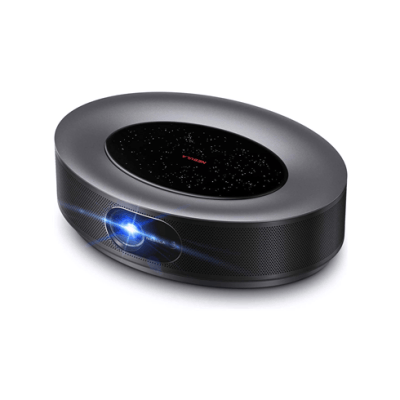
1. Anker Nebula X1 — the no-excuses backyard machine ($2,999)
3,500 ANSI lumens from an RGB triple-laser engine, a 14-element all-glass lens, 110% BT.2020 colour and Dolby Vision. On paper that reads like a dedicated theatre projector, and it is — the difference is the retractable handle, the automatic gimbal that squares the image on an uneven patio in seconds, and liquid cooling that keeps it at 26 dB so the fan does not compete with the film. It will hold a 150-inch image cleanly and stretch to 300 inches if you have the space and the darkness. At 6.1 kg it is a two-hands-and-a-plan device, not a grab-and-go one. Full specs: Anker Nebula X1.
2. Dangbei MP1 Max — the brightness-per-dollar pick ($1,999)
3,100 ISO lumens from a hybrid triple-laser-and-LED engine, 110% BT.2020 coverage, HDR10+, and a 24 dB noise floor that is quieter than most of the competition at any price. Outdoors that combination is close to ideal: enough output to start before the light has fully gone, colour that survives being spread across a 200-inch surface, and Google TV with properly licensed Netflix so nobody has to walk back inside for a dongle. Its InstanPro auto setup squares and focuses the image without the fiddling that ruins the first ten minutes of an outdoor screening. If your budget stops short of the X1, this is where the money goes furthest. Full specs: Dangbei MP1 Max.
3. JMGO N1S Ultra 4K — the gimbal bargain ($1,499)
2,800 ISO lumens, RGB triple laser, 20W of audio with DTS-HD decoding, and a 360°-horizontal, 135°-vertical gimbal that means you can drop it on a garden table and point it at a wall without stacking books under one corner. The 1,600:1 native contrast is the compromise — in a fully dark garden the black floor is visibly grey next to the Nebula — but outdoors, ambient light raises the black floor anyway, which makes this a smarter trade outside than in. Full specs: JMGO N1S Ultra 4K.
4. Dangbei Freedo — the cordless one ($499)
A 60Wh battery good for about 2.5 hours — one film, with credits — in a 1.4 kg body with an integrated gimbal and Google TV with licensed streaming apps built in. 450 ISO lumens is a genuinely dark-garden number, so plan on a 100-inch image after sunset rather than a 150-inch one at dusk. What it buys you is the ability to walk to the far end of the garden, or a campsite, with no extension cable and no compromise on which apps will actually run. Full specs: Dangbei Freedo.
Worth knowing alongside it: Dangbei’s N3 Max covers the same brief with the cord attached rather than a battery, at 1,000 ISO lumens with Netflix licensed on board, automatic focus and keystone, 12W of Dolby Audio and a mount flexible enough to throw at a wall or straight up at a ceiling. For a garden where power is not a problem, that extra output is the difference between a 100-inch image and a 130-inch one.
5. XGIMI MoGo 4 — the cordless alternative ($499)
The same 450 ISO lumens and the same battery-life ballpark, in a 208 mm cylinder with a 360° gimbal base, Harman Kardon-tuned speakers and a set of magnetic creative filters that are more fun than useful. Choose between this and the Freedo on ergonomics: the MoGo stands up and points anywhere including straight at the ceiling, the Freedo is the flatter, easier-to-pack shape. Both run Google TV with licensed apps. Full specs: XGIMI MoGo 4.
6. Magcubic HY350Max — the one you do not worry about ($99.99)
Native 1080p on a single LCD panel, Android 14 built in, autofocus and auto keystone, Wi-Fi 6, and a claimed 600 ANSI lumens. It is a dark-night, 100-inch-maximum device and the brightness claim should be treated as optimistic — but it costs less than a decent screen, it sets itself up automatically, and if it gets rained on you have lost $100 rather than $3,000. For a kids’ movie night or a garden party where the projector will be handled by people who have had a drink, that calculus matters. Our sub-$100 LCD comparison covers how it stacks up against its closest rival. Full specs: Magcubic HY350Max.
Five things that ruin outdoor screenings
Starting too early. Astronomical dusk, not sunset, is when the picture snaps into focus. Check your local time and plan the food around it, not the other way round.
Dew. Lenses and vents fog after a couple of hours in humid air, and the fan pulls moisture straight through the optical path. Bring the projector in before the grass gets wet.
Power. A 180–300W projector on a long, thin extension lead is a real voltage-drop problem. Use a heavy-gauge outdoor cable and an RCD-protected outlet.
Neighbours. Outdoor audio carries a remarkable distance. A pair of speakers placed close to the seating and turned down beats one loud speaker at the screen.
Insects in the beam. Anything flying through the light path shows up as a shadow the size of a car. Put the projector behind the seating, not in front of it, and keep a citronella candle well away from the intake vents.
Narrowing it down
Most people reading this are choosing between two of these, not six. If the patio setup is permanent and the budget is not the constraint, the Nebula X1 ends the search. If it is a budget question – and it usually is – the MP1 Max buys the most brightness and colour per dollar of anything here, and the JMGO undercuts it while keeping the gimbal and the laser engine. The two $499 machines only make sense if you genuinely need to unplug; battery convenience costs you about two-thirds of your light. And the Magcubic is the one you buy because the alternative is not watching anything outside at all this summer, which is a perfectly good reason. Full specifications for all six are in our projector database.