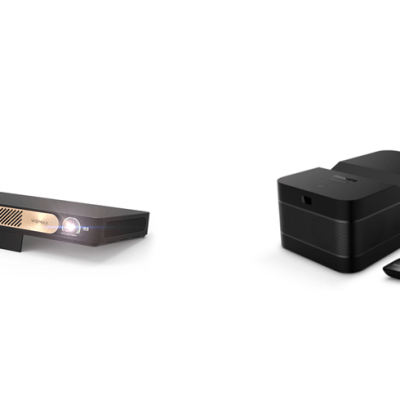
Anker has put the Nebula X1 Pro on sale in China. The rolling projector-and-speaker tower, sold at home under the name Anker Mobile Cinema X1 Pro, went up on JD.com on September 20 at 28,999 yuan, IT Home reported the same day. That is about $4,325 at this week’s exchange rate of roughly 6.70 yuan to the dollar. In the United States the same machine still lists at $4,999 on Anker’s own store and on Amazon, where it was selling for exactly that price on September 21.
The hardware is recognisably the unit Anker first showed at IFA 2025. The Chinese listing describes a 0.47-inch DMD with XPR pixel shifting to 4K, a triple-laser light source behind a mechanical dynamic iris, 56,000:1 dynamic contrast, 110 percent Rec. 2020 coverage and a 0.9:1 to 1.5:1 optical zoom. The body measures 435 x 343 x 761 mm and weighs 32.8 kg with its speakers and microphones attached. Every one of those figures matches the US product page and the numbers ProjectorReviews published when it tested the American unit in March.
The audio side is also unchanged: a wireless 7.1.4 Dolby Atmos system rated at 400 W, two opposed 5.25-inch woofers reaching down to 38 Hz, and four detachable satellite speakers that are IP54 rated and run up to eight hours on their own batteries. The tower has one HDMI 2.1 input, one USB-A and two USB-C ports, plus a telescoping handle and all-terrain wheels, which is why IT Home’s write-up pitches it as a camping machine.
Same engine, a much bigger number
One line in the Chinese spec sheet does not match. Anker’s US page rates the X1 Pro at 3,500 ANSI lumens. The Chinese listing rates it at 4,800 CVIA lumens, a figure 37 percent higher.
CVIA and ANSI are different test standards, so the two numbers cannot be converted one into the other. But the gap goes the wrong way for the usual explanation. When Chinese brands publish both ratings, the CVIA number is normally the smaller one: Dangbei rates its new X9 Ultra at 5,600 CVIA and roughly 6,100 ISO lumens. If anything, the Chinese rating should sit below the American one. Here it sits 1,300 lumens above it.
Independent measurements point the same way. ProjectorReviews measured the US unit at 4,255 lumens in its brightest mode and 3,547 lumens in its calibrated Standard mode. So Anker’s American figure looks conservative, and the Chinese figure looks generous. The only published bench number sits between the two, 12.8 percent short of the Chinese claim and 21.6 percent above the American one.
Anker has not said whether the units sold in China use a different light-engine calibration. Nothing else in the listing suggests different hardware: same chip, same contrast claim, same gamut, same weight to the tenth of a kilogram. The simplest reading is that Anker wrote one rating for a market where buyers compare spec-sheet lumens against Xiaomi, XGIMI and Dangbei, and another for a market where reviewers will put a meter on it.
Where the price lands
The price comparison is less flattering to US buyers than the headline suggests. Chinese retail prices include 13 percent VAT, while US list prices do not include sales tax. Take the VAT out and 28,999 yuan becomes about 25,660 yuan, or roughly $3,830. On that basis the American list price is about 31 percent higher for the same box, and even against the tax-inclusive Chinese price it is about 16 percent higher.
US buyers have seen lower numbers before. Anker ran a $3,999 launch promotion through the end of March, according to ProjectorReviews, and 9to5Toys spotted it at $4,299 as recently as September 15. Neither is the current price. Amazon also sells a bundle with Anker’s SOLIX C1000 power station for $5,299, and that bundle matters more than it looks: the projector tower itself has no built-in battery. Only the satellite speakers do. Anyone taking the X1 Pro camping, the use case the Chinese launch leads with, needs a generator or a power station for the projector.
In China the X1 Pro walks into a crowded top end. At 28,999 yuan it costs nearly twice what Dangbei asks for its S7 Ultra Max flagship (12,999 yuan on promotion, 15,999 yuan list), and more than three times the 7,999 yuan launch price of the X9 Ultra, both of which are rated brighter on the same CVIA scale. None of them carries a 400 W, 12-channel speaker system on wheels, and that is really what Anker is selling. The projector is one part of a portable party system, not a home theater projector that happens to have speakers.
A US-first product going the other way
The direction of travel is the unusual part. Most of the Chinese projectors we cover launch at home first and reach the US months later, often with a lower brightness figure and a higher price once they cross the Pacific. XGIMI’s Aura 3 Max took four months to make that trip, and XGIMI’s refreshed Z6X Pro, announced in China this weekend, has no US date yet.
The X1 Pro reverses that path. It debuted in Berlin, went on sale in the US first, and reached China a year after its first showing. It was cheaper on arrival, and Anker rated it brighter too. For an American shopper the two listings side by side are the clearest evidence yet that $4,999 is not a firm price. For anyone comparing it with the standard Nebula X1, which carries the same 3,500 ANSI rating in a far smaller and cheaper box, the question is whether the wheels, the tower and the 7.1.4 speakers are worth the difference. Brightness does not decide it.
For readers looking at smaller machines that fit in a backpack rather than on a trolley, our best portable projectors for 2026 covers the field.