A projector in a dark room shows an image that’s bright with deep blacks. Open the curtains and the room light falls on the screen too, so the dark parts of the image turn gray and the contrast largely disappears. There are three ways to deal with that: more light from the projector, a screen that rejects light from above and the sides, or both. This guide focuses on the first, with one ultra-short-throw pick for buyers who can set up the second.
We chose six projectors we’re tracking, ranging from $379 to about $4,000. Prices are Amazon’s as of November 13, 2026, checked on the day we published, and we’ve noted where a price has changed in our logs. Several of these will drop for Black Friday starting November 19.
Read the lumen number carefully
Lumen ratings aren’t consistent between brands. ISO 21118 and ANSI ratings are measured in a similar way and can be compared roughly with each other. “LED lumens” and unlabeled figures on cheap listings can’t. Some of those overstate real output several times over. Every projector in this guide uses an ISO or ANSI rating. We’ve also left out projectors whose only brightness claim is in the listing title.
Light source matters too. A single-chip DLP projector with a lamp or a phosphor laser shows less brightness on color images than on white, and that hurts more in a lit room, where colors already look washed out. RGB triple-laser projectors and 3LCD projectors don’t lose as much. That’s why five of the six picks below use one of those two designs.
For a sense of scale, 2,500 lumens is about the minimum for watching TV and sports during the day on a 100-inch screen with some lights on. Around 4,000 lumens is enough for a room with daylight coming in, as long as the sun isn’t hitting the screen directly.
1. JMGO N3 Ultimate: the most light for the money
$2,199 | 5,800 ISO lumens | RGB triple laser | 4K (XPR)
No other projector we track gives you as many certified lumens per dollar. The N3 Ultimate is rated at 5,800 ISO lumens, and its $2,199 Amazon price is $400 less than the $2,599 we had recorded for it before November. It also has a large optical setup for a projector on a gimbal. The 1.93x optical zoom covers throw ratios from 0.88 to 1.7:1, and lens shift goes up to 130 percent vertically. You can position the image without digital keystone, which would reduce both resolution and brightness. It supports Dolby Vision and runs Google TV with licensed Netflix. The trade-offs are 28 dB of fan noise and a native contrast rating of only 1,600:1. In a lit room, contrast matters less than in the dark, so that rating is less of a problem here than it would be in a home theater. Amazon buyers give it 4.4 stars across 86 ratings.
2. XGIMI HORIZON 30 Pro: bright and good for gaming
$2,499 ($1,899 from November 19) | 4,800 ISO lumens | RGB triple laser | 4K 120Hz
The HORIZON 30 Pro went on sale in the US this week, and XGIMI’s Black Friday price cuts $600 from it starting November 19. It’s 1,000 lumens dimmer than the JMGO. XGIMI claims a native contrast ratio of 8,000:1, and the HORIZON 30 Pro supports 4K at 120Hz with 1.9ms of input lag, which matters to anyone gaming in the afternoon with daylight in the room. It also has optical zoom and lens shift and Harman Kardon speakers. At the Black Friday price, it costs less than the JMGO while being the better all-around projector. At $2,499, the JMGO gives you more brightness for less money.
3. Dangbei MP1 Max: a big jump in brightness under $1,600
$1,599 ($1,119 at Dangbei from November 19) | 3,100 ISO lumens | triple laser + LED | 4K (XPR)
The MP1 Max pairs three lasers with an LED in one light engine, and Dangbei rates its color coverage at 110 percent of BT.2020. At 3,100 ISO lumens, it’s the least expensive projector here that we’d recommend for watching sports with the blinds partly open. It runs Google TV with officially licensed Netflix, a rarity outside the major brands. Its built-in rotating gimbal and autofocus let you set it on a shelf and aim it without a mount. Amazon buyers rate it 4.4 stars across 97 reviews, and the common themes are picture quality and how easy it is to set up. During Dangbei’s Black Friday sale, from November 19 to November 30, it costs less than any other 3,000-lumen triple-laser projector we track. It sold for $1,299 on Amazon in September, so $1,599 is not a good price to pay right now.
4. Dangbei DBOX02: the cheapest 4K laser projector to consider here
$1,199 ($899 at Dangbei from November 19) | 2,450 ISO lumens | ALPD laser | 4K (XPR)
At 2,450 ISO lumens, the DBOX02 is near the minimum brightness we’d consider for daytime use, and it reaches that level comfortably. In practice, that means a 100-inch image in a room with lamps on or light coming through curtains. For a sunny room, it’s better at about 80 inches. It runs at under 24 dB, the quietest of the six. The InstanPro system handles autofocus, keystone correction, screen fitting, and obstacle avoidance, which is useful if you move the projector between rooms. It runs Google TV with licensed Netflix and has two 12-watt speakers with Dolby Audio and DTS:X. It has been $1,199 on Amazon since early October, with 4.3 stars across 412 ratings. The lowest price we’ve recorded was $948.99 in late September. Dangbei’s own $899 Black Friday price beats that.
5. Hisense PX4 Pro: for the living room, with the right screen
$3,997.97 | 3,500 lumens (manufacturer rating) | triple laser | ultra short throw
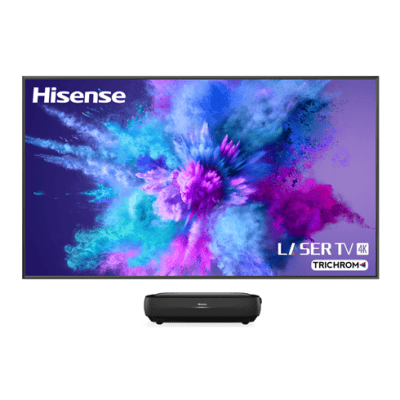
For a room that’s bright all day, the best answer isn’t a brighter projector. It’s an ultra-short-throw projector sitting a few inches from the wall, paired with a ceiling-light-rejecting (CLR) or other ambient-light-rejecting screen. These screens reflect light coming from below, where the projector is, and absorb most of the light from windows and ceiling fixtures. With the right screen, a 3,500-lumen UST projector can look more vivid in a bright living room than a 5,800-lumen long-throw projector on a plain white wall. The PX4 Pro combines a triple-laser engine with Dolby Vision and HDR10+ and Hisense’s VIDAA platform. Budget for the screen as well. Our screen guide covers the light-rejecting options, and our UST guide covers the brighter, more expensive projectors in this category.
6. Epson EpiqVision Flex CO-W01: if your budget is under $400
$379 | 3,000 ISO lumens (white and color) | 3LCD | 1280 x 800
Nothing else under $400 that we can verify comes close to this level of brightness. Epson rates the CO-W01 at 3,000 lumens for both white and color, so colors don’t lose as much brightness in a lit room as they do on single-chip DLP projectors. There are clear trade-offs. Its 1280 x 800 resolution is a step below 1080p. It uses a lamp, has no smart platform (you’ll need a streaming stick), and has a single 5-watt speaker. For presentations, kids’ cartoons in the afternoon, or a sports room where brightness matters more than sharpness, those compromises are reasonable. It sold for $329.99 for most of September and is $379 now, with 4.5 stars across 879 ratings, the most of any projector on this list. For more 3LCD and single-panel options, see our LCD projector guide.
Picking among them
Start with the room. If sunlight reaches the wall during viewing hours, choose a UST projector with an ALR screen, because no long-throw projector here can overcome direct sun. If the room is bright but the screen is out of direct sunlight, the JMGO and XGIMI are the brightest standard projectors we can recommend. The XGIMI is the better choice once it hits $1,899. If you mostly watch in the evening with some lights on, either Dangbei is a good fit. Both can be set up without a mount, and both have licensed Netflix built in. Buy them during Dangbei’s November 19 to 30 sale rather than at full price.