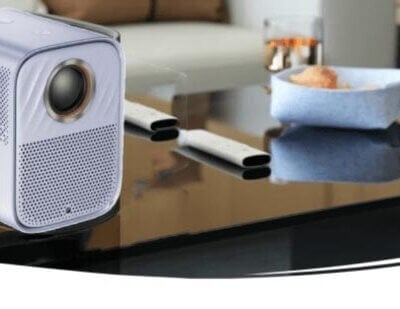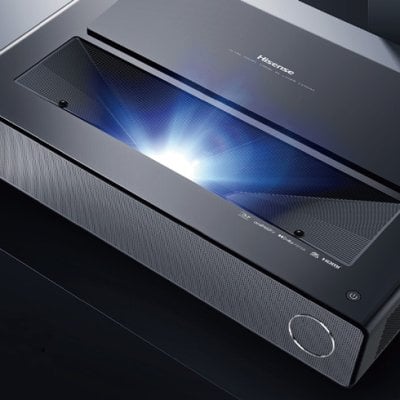
AWOL Vision put its Aetherion ultra short throw projectors on general sale in Japan on November 17, and it used the occasion to add a third, cheaper model that has not appeared anywhere else yet. The new Aetherion Plus carries a suggested price of ¥379,800 including tax, against ¥559,800 for the Aetherion Pro and ¥719,800 for the Aetherion Max. All three are now sold through AWOL’s Japanese store, Amazon Japan and Rakuten, according to the company’s PR TIMES release and a same-day report from AV Watch.
The retail launch follows a Makuake campaign that closed with ¥548,750,320 from 1,374 backers. AWOL says that ranks fourth among all projects in the platform’s history and first among ultra short throw projectors. Divide one figure by the other and the average backer committed about ¥399,000, or roughly $2,500 at today’s 159.3 yen to the dollar, which says most of the money went to the top two models rather than to accessories or low tiers.
What the Plus gives up
The Plus keeps the parts of the Aetherion design that matter most for a living room. It is still a 0.2:1 RGB triple-laser machine that throws a 100-inch image from 15.8 cm off the wall and scales to 200 inches. It still renders a 4K image with AWOL’s PixelLock processing, still claims 110% of Rec.2020, and still supports Dolby Vision, HDR10+, HDR10, HLG, IMAX Enhanced and Filmmaker Mode. Google TV is built in, along with AirPlay 2, Chromecast, Wi-Fi 7 and Bluetooth 5.4. The Japanese product page lists two 25W full-range drivers and two 20W tweeters, Dolby Atmos and DTS output, motorized focus, 8-point keystone and automatic screen alignment.
Gamers lose nothing on paper. AWOL quotes input lag as low as 1 ms at 1080p/240Hz, 4 ms at 1080p/120Hz and 2 ms at 4K/60Hz with AI processing switched off, plus VRR and ALLM. The laser is rated for more than 25,000 hours.
The cuts are in light output and black level. The Plus is rated at 2,400 ISO lumens against 2,600 for the Pro and 3,300 for the Max. Native contrast drops to 3,500:1 from 6,000:1 on both bigger models, and the dynamic figure with the iris engaged falls from 60,000:1 to 35,000:1. A 200-lumen gap is close to invisible in a side-by-side room; a native contrast figure that is a little more than half of the Pro’s is not, especially on an ultra short throw machine, where the screen and room do most of the work of holding blacks. For a buyer who watches with the lights partly on, the Plus is the sensible version. For a dark-room movie watcher, the ¥180,000 gap to the Pro buys the one spec that actually changes the picture.
Japanese street prices already sit well under the list
The suggested prices are not what AWOL’s own Japanese store is charging. On launch day the store listed the Plus at ¥360,810, a 5% cut from list, and its bundles with a 100-inch or 120-inch gray soft screen were priced at the same ¥360,810, so the screen is effectively thrown in. The Max was listed at ¥549,800 for the projector alone, and the series configurator showed the Pro at ¥439,800.
Strip out Japan’s 10% consumption tax and convert, and the numbers start to look odd next to America. The Max at ¥549,800 works out to about $3,140 before tax; AWOL’s US store sells the same projector alone for $3,999 this week, marked down from a $4,499 list, and US prices are quoted before sales tax. The Pro’s ¥439,800 is about $2,510 before tax, while the US store has it at $3,499 with no discount shown. The Plus, at ¥360,810, comes to roughly $2,060.
That is a reversal of the pattern we described when the Aetherion first went up on Makuake in August. Back then the Japanese reference prices had been set almost exactly at the dollar MSRPs, and American buyers paying discounted store prices were the ones getting the better deal. Three months on, the US Pro has climbed from the $3,199 AWOL was charging in August to $3,499, while the Japanese store is pricing both flagship models several hundred dollars under their American equivalents before tax. Some of that is the yen, which has weakened further, and some is a launch discount that may not last. But the gap on the Pro is close to $1,000, and that is not a rounding error.
A model America does not have
The more interesting question is whether the Plus will cross the Pacific. As of November 17, AWOL’s US store lists the Aetherion Max and Pro in more than a dozen screen and soundbar bundles, but no Plus. Splitting a product line by region is common in this category, and an entry model is an easy way to test demand in a smaller market before committing US inventory. A roughly $2,000-before-tax RGB laser UST with Dolby Vision and 240Hz gaming would sit below most of the triple-laser UST models in our 2026 ultra short throw guide, which is exactly where AWOL currently has nothing to sell in the US.
AWOL is also using the week to introduce its bigger machine in Japan. The LuxVision, its 6,000 ISO lumen RGB laser UST with 4K at up to 120Hz and vertical optical lens shift, will get its first public Japanese showing at Inter BEE at Makuhari Messe from November 18 to 20, set up on a roughly 130-inch screen in a mock living room. The Aetherion Max is being shown alongside it on about 120 inches, and the long-throw Valerion Max is being demonstrated with sports content. The LuxVision sells for $5,999 in the US, where it opened to buyers on November 3 after the company turned its Multiview feature into a $500 option. AWOL has not given a Japanese price.
Japanese buyers get a two-year warranty on the Aetherion series, made up of the standard year plus a free one-year extension. Whether a US version of the Plus would come with the same terms, or come at all, is something AWOL has not addressed. If it does arrive at anything near its Japanese price, it would make the Pro hard to justify for anyone who does not watch in a dark room.