Aurzen has two Roku TV projectors in Amazon’s video projector best sellers this week, and the newer one costs more. The EAZZE D1R sits at $129.98 and has been on the chart since the summer. The EAZZE E1R, which Aurzen presented at IFA in Berlin this week, sits at $139.99. The ten dollars does not buy a sharper picture. It buys a projector that weighs about a third as much.
That is an unusual way round for a portable line. Most brands add pixels as they add price. Aurzen has gone the other way: the E1R uses a 1280 x 720 panel, and Amazon’s own specification table lists 1280 x 720 as both its native and its maximum display resolution. The D1R is native 1080p. Put the two listings side by side and the cheaper machine has roughly 2.25 times as many pixels to work with.
Where the ten dollars goes
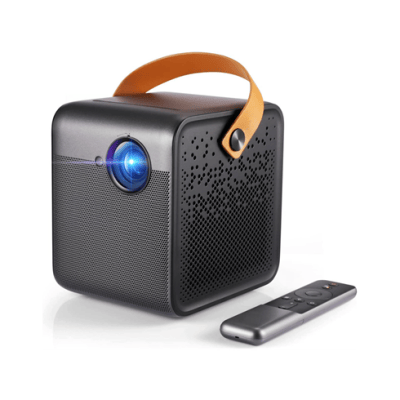
Weight, mostly. Amazon lists the E1R at 0.44 kg, a shade under a pound, against 1.4 kg for the D1R. Aurzen built it around a strap and a rotating base rather than a body and a stand, and the whole thing is small enough to travel in a coat pocket in a way the D1R never was. The base doubles as the speaker cabinet, which is where Aurzen’s marketing spends most of its energy, promising a sound chamber three times larger than the one in the outgoing model.
Larger than what, exactly, is not spelled out, and the number that matters is less flattering. Aurzen’s IFA specifications put a single three-watt driver in the E1R. The D1R carries two five-watt drivers with Dolby Audio decoding. Anyone who has run a mini projector in a backyard already knows which of those two arrangements survives an evening with a bit of wind in it.
Throw geometry shifts too. The E1R is rated 1.12:1 and covers 20 to 120 inches from between 1.6 and 9.6 feet, so it can fill a bedroom wall from close range. The D1R is 1.28:1 and quoted at 60 to 150 inches on Amazon. For a machine meant to be set down on a nightstand, the shorter throw is the right call.
The resolution nobody puts in the bullet points
Neither the five bullet points at the top of the E1R’s Amazon listing nor the product page on aurzen.com mentions resolution at all. The bullets talk about Roku, the sound base, the strap, six picture modes and two-way Bluetooth. You have to scroll past the marketing panels into the grey specification table before 1280 x 720 appears.
Compare that with the D1R listing, where “1080P Full HD Resolution” is the fourth bullet and set in capitals. Aurzen knows which number sells. When it has a weaker one it moves the number out of the way rather than printing it, and the coverage that came out of IFA filled the gap instead, reporting 720p native and 160 lumens for both new EAZZE models with 1080p accepted on the input.
None of that makes the E1R a bad screen. A 720p LCD panel at 60 or 70 inches, in a dark bedroom, at normal viewing distance, is perfectly watchable. It does mean the marketing is doing something the specification sheet is not, and a shopper comparing two Aurzen listings on the same results page has no easy way to see it.
160 lumens is a dark-room number
Brightness is where the gap gets wider than the price suggests. Aurzen rates the E1R at 160 lumens and the D1R at 280 ANSI lumens. Both figures come from the manufacturer, neither has been through an independent bench, and 160 is low even by the standards of a category where honest sub-$150 machines land somewhere between 200 and 400 ANSI.
In practice that means curtains closed, lights off, and a screen no wider than about 80 inches if the picture is to hold any punch. It also means the outdoor use in Aurzen’s own photography works only well after sunset. The D1R lives under the same constraint, but it has 75 percent more light to spend on the wall, which is roughly the difference between a picture that survives a hallway lamp and one that does not.
Anyone weighing either machine against something brighter should look at what another hundred dollars buys. We went through that field in the under-$300 guide for 2026, and the jump from 160 lumens to 500 or 600 changes what a projector is for.
What the first fifty-eight reviews say
The E1R has 58 ratings on Amazon and a 4.9 average, which is a thin sample rather than a settled verdict. What early buyers keep returning to is setup. Several describe pointing it almost straight up at a ceiling and finding the geometry already square without touching a keystone menu. Portability comes up constantly, usually in the same breath as carrying it between rooms rather than taking it out of the house.
The D1R has 1,115 ratings and 4.6 stars, and the recurring themes there are different. Fan noise is the one owners mention with relief; people who had been burned by loud projectors report that this one stayed quiet enough through a backyard film to be forgotten. The built-in speaker draws praise as adequate rather than good, and more than one buyer notes that the Roku interface was the reason they chose it over a cheaper machine that needs a dongle. That last point is the whole argument for either projector, and it is the one we made when a $99.99 Roku model landed against a sharper rival fifty dollars above it.
The price that flickered
There is a wrinkle in the E1R’s launch worth recording. Aurzen’s IFA materials list a $139.99 US price with an $89.99 introductory offer, and neither Amazon nor aurzen.com was showing $89.99 on September 3. But on September 1, deal trackers including DealNews logged an E1R listing on Amazon at $59.99 against a $140 list price, a 57 percent cut on a model Aurzen was presenting in Berlin the same week. That listing is a second ASIN for the same model, and it now reads “Currently unavailable” with no restock date. The one still trading, and the one sitting at number ten in Amazon’s projector chart, is the $139.99 version.
Launch-week pricing on this shelf moves fast enough that no single reading should be treated as settled. What can be said is that a model carrying a 139.99 list price and briefly trading at 59.99 in the same week has a lot of room in it.
Which one belongs in which room
The D1R is the better projector on paper and the better buy at the till. More pixels, more light, more speaker, ten dollars less, and a thousand more reviews behind it. If it is going to live on a shelf and point at the same wall every night, there is no argument for the E1R.
The E1R earns its money in exactly one scenario, and it is a common one: a projector that gets picked up. Under a pound with a strap on it, it goes to a friend’s flat, a hotel room or a child’s bedroom without a bag being packed for it, and the Roku layer means nothing else has to travel with it. Aurzen has priced it as a convenience item rather than a picture-quality one, which is honest enough as long as the listing is read to the bottom. Whether the convenience is worth a tenner more than a sharper, brighter machine comes down to how often the thing actually moves.
The two are lined up on our side-by-side comparison page if you want the specification tables next to each other, and both sit in the sub-$150 tier of the portable projector guide.