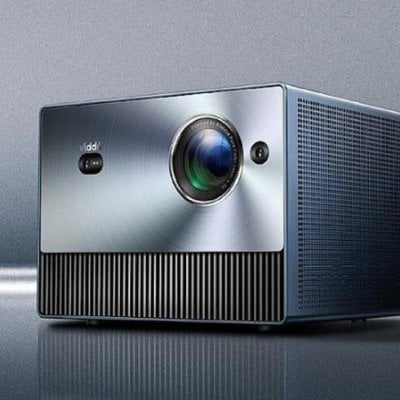
Honor has opened reservations for its brightest projector so far. The HONOR Life AI Projector Ultra, sold in China as the 荣耀亲选 AI 投影仪 Ultra, went up on JD.com on September 22 with a list price of 2,599 yuan, about $388, and a price of 1,999 yuan, about $298, once China’s national appliance subsidy is applied. It goes on sale on September 28. IT Home reported the listing the same day, and so far the machine has no page on Honor’s own website and no announced release outside China.
The headline number is 1,700 CVIA lumens, a rating Honor’s promotional material says was certified by CESI, the China Electronics Standardization Institute laboratory. The projector is native 1080p (1920 x 1080), accepts 4K input, decodes HDR10 and China’s HDR Vivid format, and is quoted at 3,000:1 contrast. Inside is an eight-core chip Honor identifies only as the V670, with 2GB of memory, 64GB of storage and MEMC motion interpolation. Fan noise is rated as low as 30dB. Audio comes from a 24W speaker system in a 400cc chamber, tuned with the Danish speaker maker Vifa.
The rest of the feature list is the standard Chinese mid-range kit: automatic focus, keystone correction, obstacle avoidance and screen fitting, plus a remote with a touchpad and air-mouse pointing. One feature is less common. Honor sells a stylus that turns the projected image into a touch surface, pitched at meeting notes and children’s drawing. The listing does not say how the touch is tracked.
A single LCD, like the rest of the family
Honor’s material does not use the words “single LCD” for the Ultra, but it describes a fully sealed light engine, a double-glass heat shield between the light source and the panel, and a “polariser-free” panel, which is the vocabulary of single-LCD light engines rather than DLP. Honor’s official page for the cheaper Life AI Projector Air states the technology outright: 1LCD, 280 CVIA lumens, native 1080p, a HiSilicon quad-core chip and a 1.22kg body.
That puts the Ultra at the top of a range Honor has built in about ten months. The Air arrived last November at a subsidised 499.8 yuan. A Pro model followed in May, listed on JD.com at 750 CVIA lumens. The Ultra now rates 1,700. That is roughly six times the Air’s light output in less than a year, from a phone company that does not make projectors itself; the 荣耀亲选 label is Honor’s ecosystem programme, under which partner manufacturers build products sold under the Honor name.
Where it lands in the Chinese market
The obvious comparison is the OBE R3 Ultra Max, which went on sale on September 11 at 3,999 yuan, about $597. OBE’s machine is rated at 1,800 CVIA lumens, so on paper Honor delivers 94 percent of the light for 65 percent of the list price. Per rated lumen, the Honor works out to about 1.53 yuan and the OBE about 2.22.
The OBE does spend the difference on real hardware. It has a gimbal that tilts 120 degrees and rotates 360, two HDMI 2.1 ports with eARC, 4GB of memory and a dedicated 25W subwoofer in a 1,070cc chamber, and its panel and light engine come from TCL CSOT and its subsidiary, which is the only confirmed supply chain in this segment. Honor has not said who makes its panel or its light engine, and its listing does not specify HDMI version or port count. A buyer comparing the two is choosing between a well-documented premium box and a cheaper one whose headline number is certified but whose internals are not published.
What both confirm is how fast the Chinese single-LCD market is moving. Two large consumer brands are selling single-LCD projectors rated between 1,700 and 1,800 CVIA lumens within a fortnight of each other, one of them with a subsidised price below 2,000 yuan.
Why it matters outside China
The contrast with the American market is sharp. On Amazon in the United States, single-LCD projectors are overwhelmingly unbranded machines selling between $60 and $150, with brightness figures that no standard body has checked; the median price of the bestseller list has hovered around $60 all summer, as we found when we looked at how the research firms have started counting 1LCD. The best of those US listings claim “native 1080p” and five-figure “lumens” numbers that bear no relation to what reaches a screen.
In China, CVIA ratings have forced brands to compete on a number that is measured under one procedure, and the result is that single LCD is being pushed upmarket by brands that have reputations to lose. CVIA lumens are not ANSI lumens, and nobody should read 1,700 CVIA as 1,700 ANSI without a meter in the room. But the direction is clear, and the first of these machines that arrives in the US with a certified rating and a known brand name will make the $100 no-name shelf look very old very quickly.
Honor has not said whether the Ultra will leave China, and the Ultra has no English-language product page yet.